FRAM instead of Flash — why it matters for this MCU
What sets it apart from conventional MSP430 parts is its 32KB program memory implemented in FRAM (ferroelectric RAM) rather than Flash or EEPROM. FRAM writes at bus speed with no erase cycle overhead, draws negligible write current, and is rated for endurance far beyond Flash — useful for data-logging applications that update non-volatile storage on every sensor read. The 2K x 8 SRAM handles stack and temporary variables; the 32KB FRAM serves double duty as both code store and data memory, so you can partition it between firmware and non-volatile data buffers without a separate EEPROM.
Peripheral set for metering and display applications
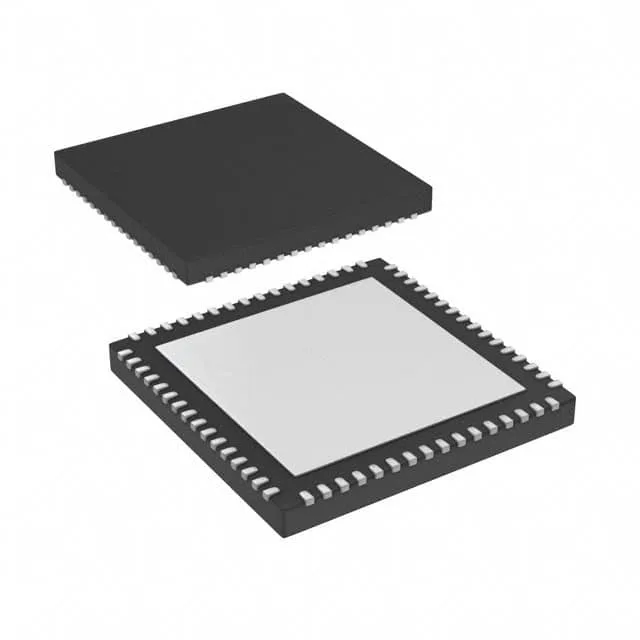
This MCU integrates an LCD driver, a 12-bit ADC with 8 channels, a brown-out reset circuit, DMA, PWM, and a watchdog timer. The 52 I/O lines in the 64-VFQFN package provide enough headroom for a keypad matrix, sensor interfaces, and a parallel LCD bus if needed.
Connectivity and serial interfaces
The IrDA support is less common on low-power MCUs and matters for IR data links in handheld terminals or optical isolation barriers.
Operating from 1.8V to 3.6V, this part runs directly from two alkaline cells or a single Li-ion through its discharge curve.
Lifecycle and sourcing posture
Listed as Active by Texas Instruments, so there is no end-of-life clock ticking on this part. No second-source alternate is recorded in the available cross-reference data, so dual-sourcing would require a pin-compatible sibling within the MSP430FR6820 family — check the base product number MSP430FR6820 for other density or temperature variants.
