64 KB FRAM — the memory that writes like RAM and holds like Flash
Its program memory is 64 KB of FRAM — ferroelectric RAM that combines the non-volatility of Flash with byte-addressable, near-instant writes at full speed. No erase cycles, no write-before-erase delays, and endurance rated orders of magnitude beyond typical Flash. For a firmware engineer, this means you can treat the code space like a data logger: update calibration tables, store system logs, or implement OTA staging without wear-leveling gymnastics. The 2 KB of conventional SRAM handles stack and scratchpad.
51 I/O and a full peripheral set in a 9x9 mm QFN
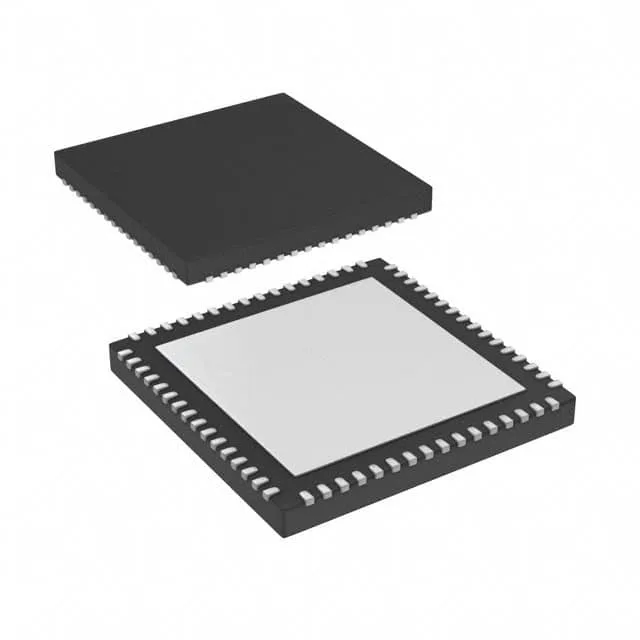
With 51 I/O lines from a 64-VFQFN package (9x9 mm body, 0.5 mm pitch), this part packs a surprising number of signals into a compact footprint. The exposed thermal pad needs a via array under the die attach pad for both thermal relief and a solid ground return. Decoupling pairs of 0.1 µF and 1 µF ceramics per supply pin pair is the baseline; the internal LDO regulator for the core logic benefits from a 2.2 µF on Vcore if the datasheet app note calls for it.
Industrial temperature range and active lifecycle
The lifecycle status is Active — no NRND flags, no LTB window. The base product number MSP430FR5922 spans multiple package and temperature variants; the IRGCR suffix identifies this specific 64-pin QFN reel option.
Connectivity and analog integration
The 8-channel 12-bit ADC samples at rates suitable for single-cycle current sensing or temperature monitoring. An internal oscillator keeps the clock tree self-contained for cost-sensitive designs, though an external crystal can be routed through the dedicated pins for tighter timing.