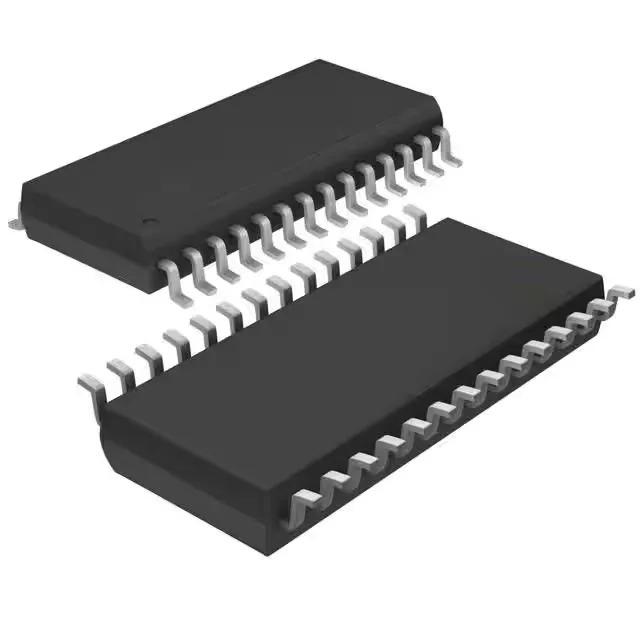
Its program memory is 4 KB of FRAM — a nonvolatile memory that writes at bus speed with no erase cycle, so firmware updates and data logging don't stall on page-erase latency the way Flash-based parts do. The 1K x 8 SRAM holds stack and small buffers; the 21 I/O pins on the 28-TSSOP package give enough headroom for a sensor cluster or a simple HMI with a few buttons and LEDs. Internal oscillator keeps the BOM count low — no external crystal needed for the core clock, though the internal oscillator is rated for the 8 MHz speed grade.
Industrial temperature grade and deployment
The 28-TSSOP package is a surface-mount footprint with 0.65 mm pitch — standard for automated assembly and rework.
Serial connectivity and analog integration
On the digital side, the MSP430FR5720IPW brings I²C, SPI, UART/USART, LIN, and IrDA — enough to talk to common sensors, displays, and industrial bus transceivers without glue logic. The 10-channel 10-bit ADC handles analog inputs like thermistor voltages or current-sense resistor drops, with the brown-out detect and POR ensuring clean startup.
Lifecycle — active, no LTB pressure
Texas Instruments lists the MSP430FR5720IPW as Active. For a production BOM, this means no urgency to qualify a second source — though the MSP430 FRAM family includes pin-compatible siblings with higher memory densities if the firmware grows.
