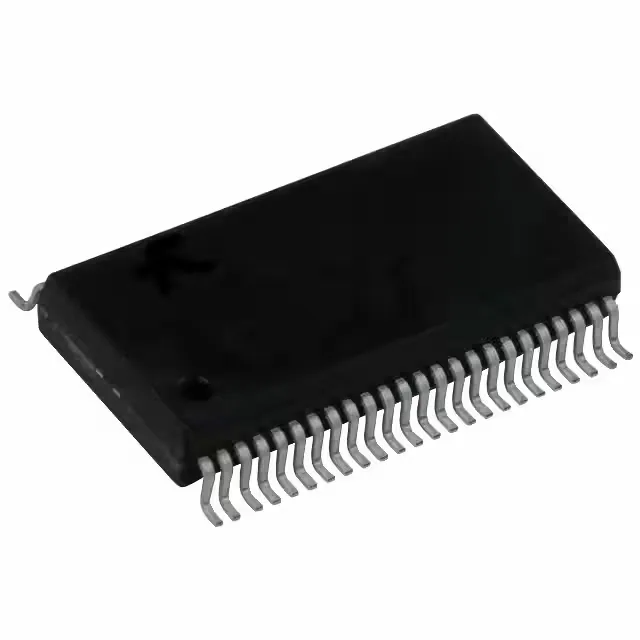
Its headline feature is 15.5 KB of FRAM program memory — nonvolatile storage that writes at near-SRAM speed with effectively unlimited endurance (10^15 cycles typical), eliminating the erase-before-write penalty and wear-leveling overhead of Flash. The part also integrates a segment LCD driver with an internal charge pump, so a glass LCD panel connects directly to the MCU pins — no separate display controller IC needed.
16 MHz core — enough for the job, not for number crunching
The 16 MHz clock is modest by today's MCU standards, but this part isn't aiming at the performance tier. It's sized for control-loop and user-interface tasks where the FRAM's fast writes and the LCD driver's low overhead matter more. At 16 MHz the CPU can service a UART at 115200 baud, poll an ADC channel, and update a segment LCD in the same interrupt cycle without timing pressure.
The 48-TSSOP package (6.10 mm body width, 0.5 mm lead pitch) is a fine-pitch surface-mount part. The PCB land pattern needs a solder-mask-defined pad with a stencil aperture sized for 0.5 mm pitch to avoid bridging. The supplier device package is 48-TSSOP, so footprint compatibility across the MSP430FR4133 family is consistent — the IG48 and IPM variants share the same pad layout.
Industrial temperature grade — where it runs and where it doesn't
It covers factory automation, outdoor telecom cabinets, automotive cabin (non-engine-bay), and commercial HVAC.
The FRAM family is a current TI portfolio focus, so long-term supply looks stable — but as with any sole-sourced MCU, qualifying a backup variant (e.g., the MSP430FR4133IPM in a different package) for dual-sourcing is worth the engineering effort if the BOM volume justifies it.