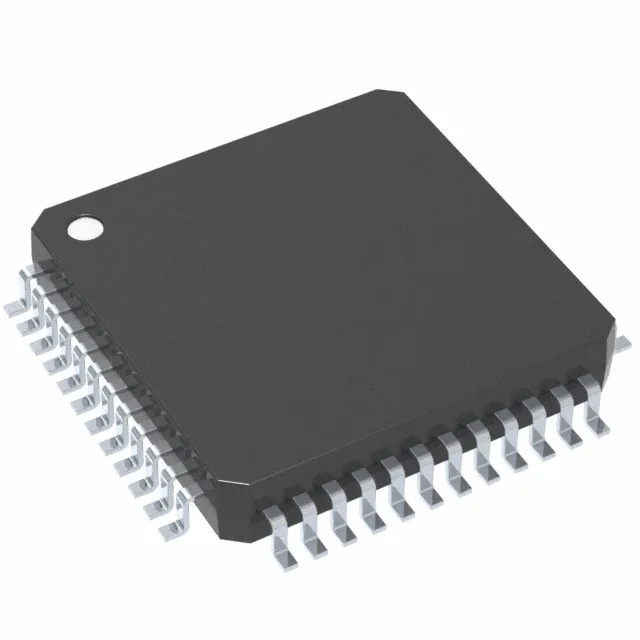
What this MSP430 FRAM MCU brings to a board
Its program memory is 16 KB of FRAM — non-volatile like Flash but with faster write speeds, lower write power, and much higher endurance, which matters if you are logging data or doing frequent field updates. The 2K x 8 SRAM handles the stack and scratchpad.
FRAM vs Flash — why it matters on this part
The MSP430FR2153TPTR uses FRAM for its 16 KB program store, not conventional Flash. Endurance is effectively unlimited for practical embedded lifetimes — you are not counting erase cycles. For a design that stores calibration data or runs a state machine that rewrites configuration often, this part avoids the wear-leveling overhead a Flash MCU would need.
The MSP430FR2153TPTR comes in a 48-pin LQFP package (7x7 mm body) with a 0.5 mm pitch, surface-mount only. The 44 I/Os are all 5 V tolerant on the digital inputs, which simplifies level-shifting when interfacing to legacy 5 V logic.
For a BOM line you are qualifying today, there is no LTB risk.