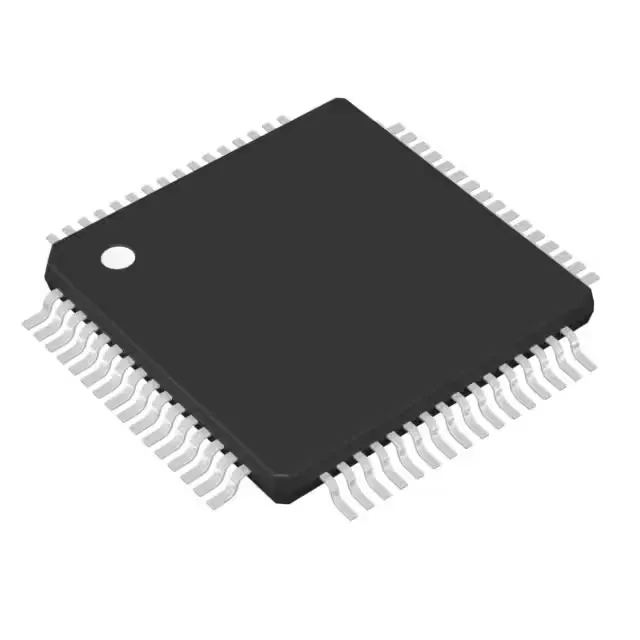
What this MSP430 does on the board
What sets this part apart is the on-chip LCD controller and three 16-bit sigma-delta ADCs — peripherals that target it squarely at single-phase energy metering, instrumentation, and sensor-interface designs where the display and analog front-end live on the same MCU. The 14 general-purpose I/O lines handle local control and status, while SPI and UART/USART connectivity link to external communication modules or data loggers.
Memory and peripheral budget for the BOM
With 16 KB of Flash and 512 bytes of RAM, this MCU fits firmware that is single-function and deterministic — think a metering algorithm with a periodic LCD update, not a multitasking RTOS with large data buffers. The 8.4 MHz core speed is enough to execute the metering math (multiply-accumulate for power calculation) within a line-cycle window, but leaves no headroom for software-driven protocol stacks. The three 16-bit ADCs can sample voltage and current channels simultaneously, which is the typical architecture for a basic energy-measurement front-end. The brown-out detect and POR circuits reduce external supervisor IC cost.
That said, the MSP430FE4xx series is a mature portfolio; keep an eye on TI's PCN notifications for any future transition. For BOM resilience, the base product number MSP430FE425 covers multiple package and temperature variants, so a shift to a different suffix (e.g., MSP430FE425IPM) is possible if the Tape & Reel option becomes constrained.