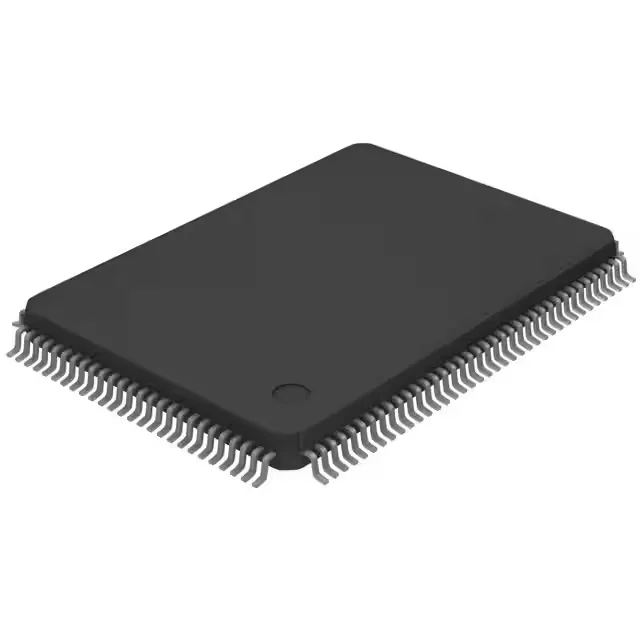
It carries 128KB of Flash program memory and 16K x 8 of RAM, with 90 I/O lines brought out to a 128-LQFP package. The distinguishing feature on this part is the set of six 24-bit sigma-delta ADCs — that's the block that makes it a fit for polyphase energy metering, precision instrumentation, and industrial sensor front-ends where you need simultaneous multi-channel measurement.
Beyond the sigma-delta converters, the peripheral list includes a brown-out detect and reset, POR, DMA, an LCD driver, PWM timers, and a watchdog timer. There's also an internal oscillator, so you can save a crystal in cost-sensitive builds if the accuracy budget allows.
The supply range of 1.8V to 3.6V lets it run from a single Li-ion cell or a 3.3V rail without an extra regulator, though the sigma-delta ADCs will need a clean analog supply for full 24-bit performance.
Lifecycle reality — this part is obsolete
There is no official TI successor listed for this exact order code, so the replacement path means evaluating a pin-compatible sibling in the MSP430F6xx family or migrating to a newer MSP430 generation.
What the 25 MHz and 6x24-bit ADC mean for your design
The 25 MHz core speed is modest by today's 32-bit standards, but the MSP430 architecture is lean — it can service the six sigma-delta ADCs, run the metrology algorithm, and drive an LCD segment display without breaking a sweat. The real value is the 24-bit resolution on six simultaneous channels: that lets you sample voltage and current on all three phases of a three-phase power system plus a neutral channel, all synchronously. If your application only needs one or two channels, you're paying for silicon you won't use, and a smaller MSP430 variant might be a better fit.