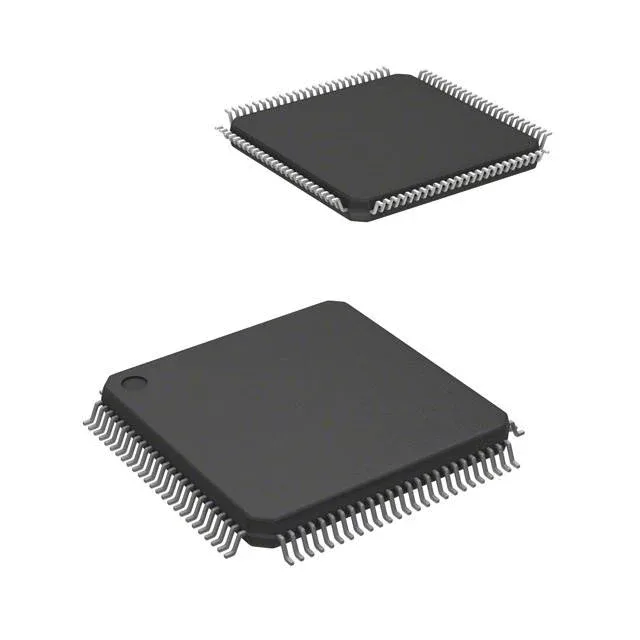
Metering-class MSP430 with three 24-bit sigma-delta ADCs
The Texas Instruments MSP430F67621AIPZR is a 16-bit ultralow-power MCU from the MSP430F6xx series, built around the MSP430 CPUXV2 core running at 25 MHz. The standout feature is the three 24-bit sigma-delta ADCs — this part is designed for polyphase energy metering, power-quality monitoring, and precision sensor front-ends where multiple high-resolution simultaneous conversions are needed. Additional data conversion comes from an 8-channel 10-bit SAR ADC. The device operates from 1.8 V to 3.6 V over the industrial temperature range of -40°C to 85°C, and is packaged in a 100-LQFP (14×14 mm) with 72 I/O lines.
What the 25 MHz core and 24-bit ADC bank mean for the BOM
The 25 MHz CPUXV2 is not a high-throughput general-purpose core — it is a low-power signal-processing engine sized to service three simultaneous 24-bit sigma-delta conversions. Each ΣΔ converter runs independently, so the MCU can capture voltage and current on three phases without external multiplexing or a separate AFE. The 4 KB RAM is tight; the application code must stream conversion results out via I²C, SPI, or UART rather than buffering large blocks locally. Designs targeting single-phase metering or fewer channels can step down to a smaller MSP430F6xx variant, but the 3×ΣΔ bank is the reason to pick this specific order code.