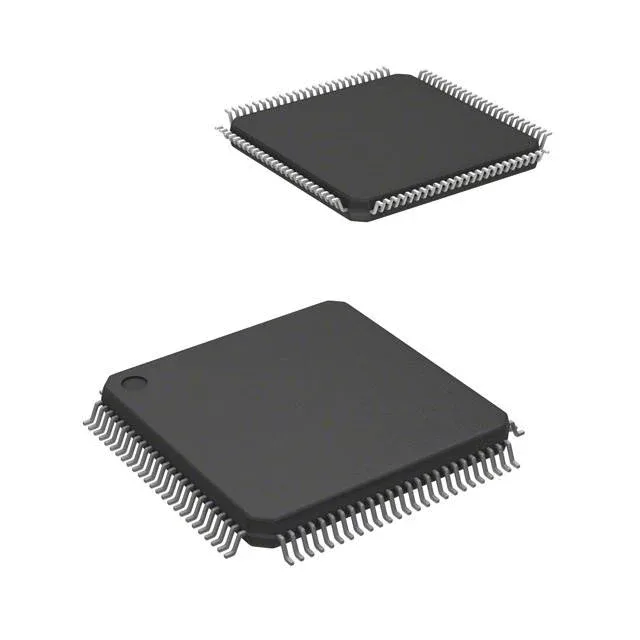
25 MHz core, three 24-bit ΣΔ ADCs — metrology-class mixed-signal MCU
The Texas Instruments MSP430F67621AIPZ is a 16-bit microcontroller from the MSP430F6xx family, built around the CPUXV2 core running at 25 MHz. What sets this part apart from a general-purpose MCU is the analog front-end: three independent 24-bit sigma-delta converters alongside an eight-channel 10-bit SAR ADC.
What the 25 MHz and 4 KB RAM mean for a metering design
At 25 MHz the CPUXV2 can keep up with three ΣΔ channels running at moderate oversampling rates, but 4 KB RAM is the real constraint. Each ΣΔ channel needs a buffer for post-processing — voltage, current, phase angle, power accumulation — and the 4 KB budget forces a lean firmware architecture. If your algorithm calls for multi-cycle averaging or harmonic analysis, you'll be trading buffer depth against feature count. The 64 KB Flash is generous for the metering stack itself; the RAM is where the design lives or dies.
End-of-life — sourcing reality for the BOM line
I/O and connectivity — 72 pins, serial interfaces, LCD drive
72 I/O lines in a 100-pin LQFP. Serial interfaces include I²C, SPI, UART, and IrDA.
Temperature grade and operating range
Rated for -40°C to 85°C ambient with a supply range of 1.8 V to 3.6 V. That is industrial temperature, not extended automotive — fine for a utility meter enclosure, outdoor telecom cabinet, or factory-floor sensor node.