What this MSP430 brings to a metering or instrumentation BOM
The distinguishing feature set is the four integrated 24-bit sigma-delta analog-to-digital converters and a segment LCD controller, both on the same die. This combination targets designs that need to digitise multiple analog channels (voltage and current sense from a power grid or sensor array) and drive a local LCD panel directly, all while keeping the BOM count low.
The 25 MHz CPU clock is the throughput ceiling for this MSP430. For a polyphase metrology application running a 24-bit sigma-delta conversion loop, the 25 MHz rate gives enough MIPS to compute active/reactive power, harmonics, and RMS values in software while still servicing the LCD refresh and a UART or SPI communication link. If the design needs a faster control loop or software-based FFT at higher bin counts, the 25 MHz ceiling is the constraint to budget against.
Four 24-bit sigma-delta ADCs and LCD drive — the integration win
The MSP430F67471AIPEU packs four independent 24-bit sigma-delta ADCs, each with its own programmable gain amplifier and digital filter. This is the peripheral that saves a separate analog front-end IC in a three-phase energy meter or a multi-channel sensor hub. The LCD controller drives a segmented display directly, eliminating a separate display driver chip. The part also includes a brown-out detect, POR, PWM timers, and a watchdog timer — the usual supervisory peripherals for an industrial or instrumentation design.
Connectivity and I/O for a mixed-signal system
The I²C and SPI interfaces can operate simultaneously — the peripheral set is independent, so a sensor read over SPI does not block a display update or a calibration command over I²C.
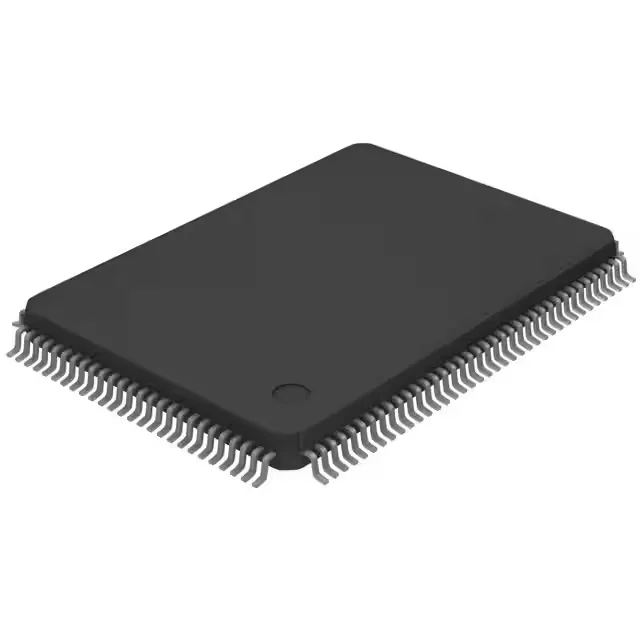
Housed in a 128-pin LQFP (20x14 mm body), the MSP430F67471AIPEU is a surface-mount part suitable for automated assembly.