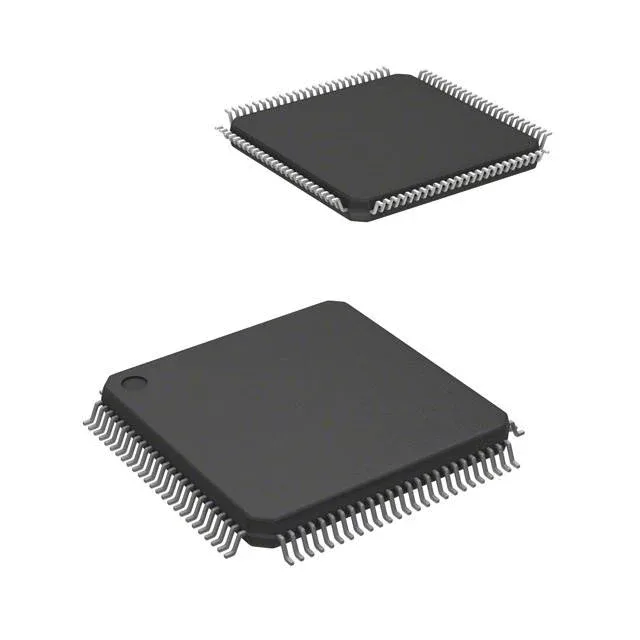
What this 16-bit MCU brings to a panel or instrument design
The Texas Instruments MSP430F6724IPZR is a 16-bit microcontroller built around the MSP430 CPUXV2 core, running at 25 MHz. What sets this part apart in the MSP430F6xx family is the integrated LCD driver — it can drive a segment LCD panel directly, no external display controller needed — and a dual ADC block: eight 10-bit channels plus two 24-bit sigma-delta converters. That 24-bit path is the headline feature for any design that needs precision analog measurement: weigh scales, flow meters, pressure transducers, or temperature bridges. The supply range is 1.8 V to 3.6 V, and the operating temperature covers -40°C to 85°C, so it fits industrial control cabinets and outdoor telecom enclosures without a heater.
25 MHz clock and on-chip oscillator — no external crystal needed
The internal oscillator covers the 25 MHz system clock, so you can skip the external crystal and its load capacitors on the PCB. That saves two components and a pair of traces, which matters when board area is tight in a 100-pin LQFP layout. The CPUXV2 core is a 16-bit RISC architecture with a hardware multiplier; it handles control loops and communication stacks without a cache or external memory bus.