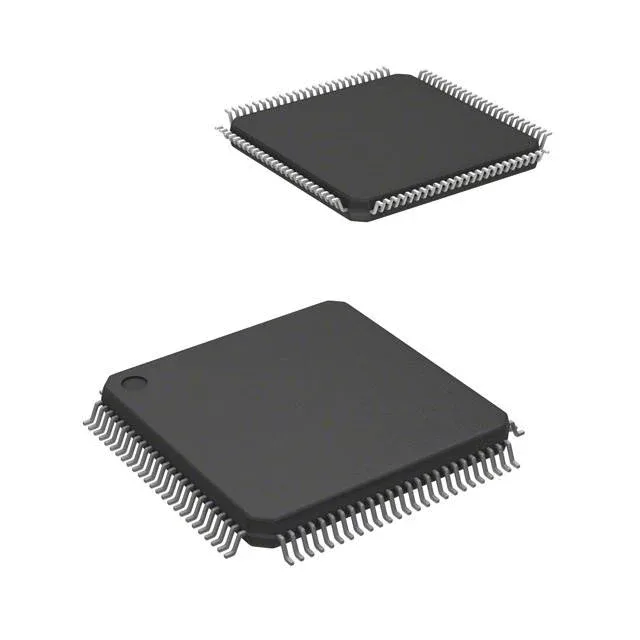
What the MSP430F5631IPZR is and what it brings to a board
It comes in a 100-pin LQFP package (14x14 mm body), surface-mount only.
The 20 MHz clock rate is the maximum for this CPUXV2 core. At that speed, single-cycle instructions execute in 50 ns. The core includes a hardware multiplier, DMA controller, and a 16-bit RISC architecture that keeps interrupt latency predictable. If your application needs tighter loop timing or higher throughput than 20 MHz can deliver, you would be looking at a different family — this part sits in the mid-range performance tier of the MSP430 portfolio.
192 KB Flash and 18K x 8 RAM — sizing the firmware and data buffers
192 KB of Flash is enough for a moderate-complexity application with a USB stack, a few protocol handlers, and application logic. The 18K x 8 RAM (18 KB) serves as scratchpad for data buffers, USB endpoints, and stack. If you are porting code from a smaller MSP430, watch the memory map — the Flash is organized as 192K x 8, meaning byte-addressable, and the RAM is 18K x 8. The Flash endurance is rated for 100k write/erase cycles per sector, typical for this family, so wear-leveling in the filesystem layer is advisable if you write frequently to the same sectors.
USB 2.0 and serial connectivity — what interfaces are on the pins
The USB 2.0 peripheral is a full-speed (12 Mbps) device controller with integrated PHY. It shares pins with the UART and other serial modules, so you need to configure the pin mux carefully. The part also includes two I²C modules, four SPI channels, and two UARTs with IrDA and LIN support. The 74 I/O lines are multiplexed across these peripherals, leaving plenty of GPIO for sensors, switches, and display interfaces. Brown-out reset, power-on reset, and a watchdog timer are built in, which simplifies the external supervisor circuit.
This part is no longer available through authorized distribution channels as a new-production device. Sourcing is limited to the surplus and broker market, where inventory is finite and pricing reflects scarcity. If you have an existing design using this MCU, you need to qualify a replacement or secure a lifetime buy of remaining stock. The 100-LQFP footprint is shared across several MSP430F5xx variants, so a pin-compatible migration within the family is the most practical path.