32KB Flash and 10KB RAM — sizing the firmware budget
The 32KB Flash (32K x 8) is the program store, and the 10K x 8 RAM handles data and stack. For a USB-enabled application — say a data logger or a simple HID device — the USB stack plus the application firmware typically consumes 12KB to 18KB of Flash, leaving headroom for field updates or added features. The 10KB RAM is generous for a 16-bit MCU at this tier; it can buffer a few USB packets (each 64 bytes for full-speed) without thrashing. If your design needs more code space, the MSP430F5529 variant in the same package doubles the Flash to 128KB — a drop-in swap if you plan ahead.
1.8V to 3.6V supply — battery-friendly range
The 1.8V to 3.6V operating range covers two common scenarios: running directly from a 3.6V Li-ion cell (or a 3.3V regulator) and, at the low end, operating from two alkaline cells or a 1.8V rail in deeply embedded systems. The internal oscillator and brown-out reset work across the full range, so no external supervisor is needed for undervoltage lockout. At 25MHz the core draws more current at 3.6V than at 1.8V, but the active power scales roughly linearly with voltage — a consideration for battery life in always-on sensing roles.
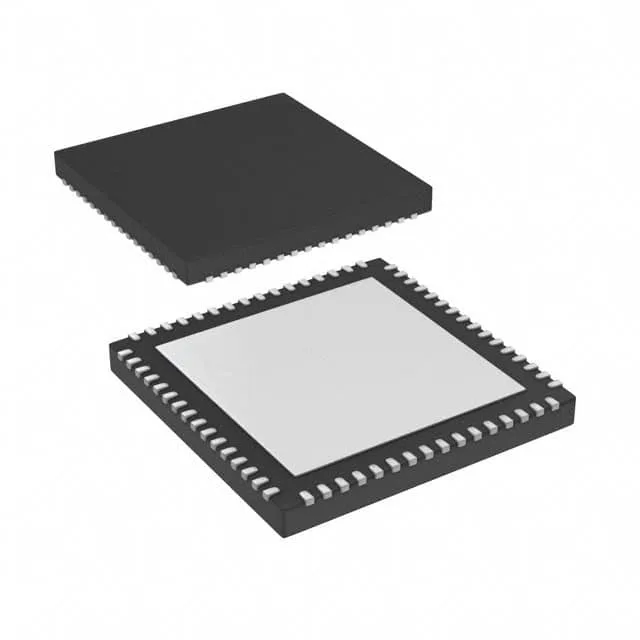
64-VQFN package — hand-solderable with care
The MSP430F5522IRGCT comes in a 64-VFQFN with exposed pad, also specified as a 64-VQFN measuring 9x9 mm. The package is surface-mount only, so no through-hole alternative exists in this family.
No last-time-buy or end-of-life notice has been issued for this base part number. For long-term supply planning, the MSP430F5xx family has broad second-source compatibility within TI's own portfolio — the MSP430F5529IRGCT is a higher-density sibling in the same package and pinout, but it is not a second source from another manufacturer.