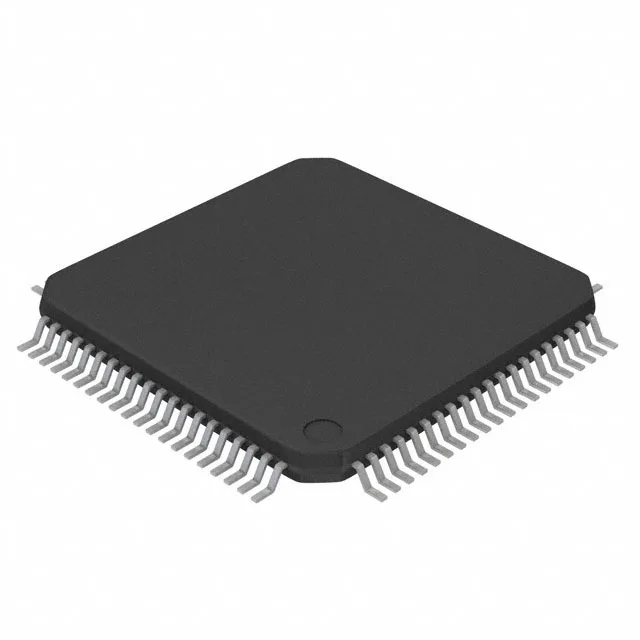
The MSP430F5435AIPNR runs the 16-bit CPUXV2 core at 25 MHz, which is the practical ceiling for this family. At that speed, single-cycle multiply and hardware multiplier keep interrupt latency tight — expect sub-200 ns response to a wake-from-sleep event. The 25 MHz clock is enough for a 10 kHz control loop with headroom for communications overhead, but not for real-time audio or video processing.
Both memories are on a single internal bus, so no wait-state penalty for Flash access at 25 MHz.
80-LQFP — rework and layout notes
The 80-LQFP (12x12 mm) is a standard fine-pitch gull-wing package. The exposed pad (thermal pad) on the bottom is not present on this package; all 80 pins are peripheral. Keep the solder paste stencil at 0.125 mm thickness for consistent fillets. MSL is 3 — bake at 125°C for 24 hours if the moisture barrier bag has been open longer than the floor life.
The DMA controller can move ADC results to RAM without CPU intervention, which is useful for data logging at moderate rates. The internal oscillator is trimmed to ±1% accuracy, so you can skip the external crystal for UART baud rates up to 115200 — but for CAN or precision timing, an external clock is still recommended.
This is a standard catalog part, not a niche or legacy device, so lead times through distribution are generally stable. For the current price and availability, submit an RFQ — we source through independent distribution and confirm pricing and stock at quote time.