What the NRND status means for your BOM
For a new design, TI would rather you pick a current MSP430F5xx or MSP430F6xx variant.
18 MHz core — enough for control-loop and sensor-fusion tasks
The MSP430 CPUXV2 core runs at 18 MHz. That is not a high-throughput number by today's 200 MHz ARM standards, but for the MSP430's sweet spot — battery-operated sensing, data logging, and control loops — 18 MHz is a deliberate trade-off that keeps active current low. The 16-bit architecture with the hardware multiplier handles 16x16-bit multiply-accumulate in a single cycle, so PID loops and digital filtering run without stalling the pipeline. If your algorithm needs more than about 10 MIPS of sustained integer throughput, you are looking at the wrong family.
The 16 KB SRAM (16K x 8) is enough for moderate data logging and communication buffers. If your application streams sensor data over UART or SPI while running a control loop, budget the SRAM for double-buffering: 16 KB gives you about 8 KB per buffer, which is comfortable for 12-bit ADC samples at moderate rates.
Industrial temperature range and 87 I/O — where it fits
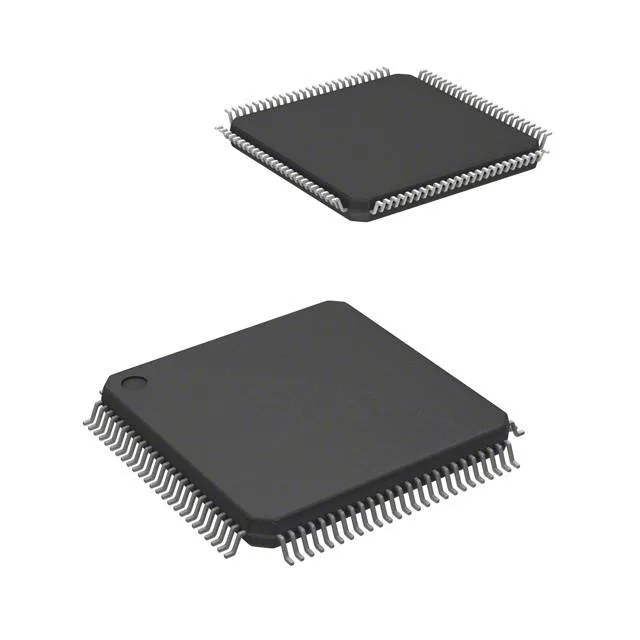
The 14x14 mm body is hand-solderable with a fine-tip iron, though reflow is the production norm.