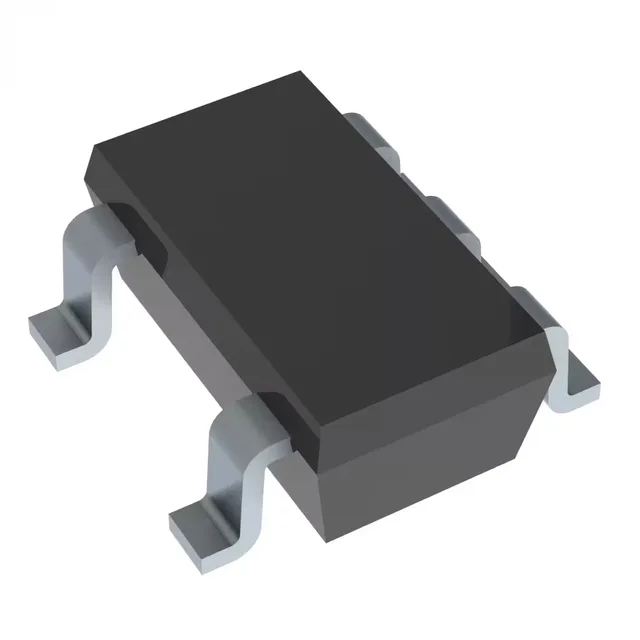
750 nA quiescent comparator for battery-powered threshold sensing
The 30 µs propagation delay (max) places this part in the low-speed sensing domain: battery undervoltage lockout, over-temperature detection, window comparators for sensor thresholds, and wake-up signal generation. It is not a candidate for high-frequency PWM loop control or fast overcurrent trip circuits — the delay is two orders of magnitude slower than a typical 100 ns comparator. The 98 dB CMRR and 82 dB PSRR give it clean threshold accuracy in noisy mixed-signal environments, and the 0.4 pA input bias current (max at 5 V) means it can interface with high-impedance sources like photodiode transimpedance stages without loading the signal.
Supply range and power — where the 750 nA matters
The 750 nA quiescent current is the maximum over temperature, not a typical — a design targeting a 10-year battery life on a 200 mAh cell has a standing budget of roughly 2.3 µA for the entire system, and this comparator consumes about a third of that.
Housed in the SOT-23-5 (SC-74A) package, it is a five-pin device with a 0.95 mm pitch — standard for hand-assembly and automated optical inspection. The ROHS3 compliance means no exemptions for lead in solder, which simplifies the compliance declaration for EU-market products.