152 kHz GBW and 28 µA — the selection niche
That combination — low bandwidth, ultra-low quiescent draw — places it squarely in the battery-powered sensor conditioning and always-on monitor niche, not in audio or high-speed control loops.
A 152 kHz gain-bandwidth product means the part has unity-gain bandwidth of about 152 kHz. For a closed-loop gain of 10, the usable signal bandwidth drops to roughly 15 kHz — fine for thermocouple conditioning, current-sense amplifiers, or low-speed filter stages, but not for switching-regulator compensation or audio above voice-band. That is adequate for DC and quasi-DC signals; expect slew-induced distortion above a few kilohertz at full swing. If the design needs faster edge rates, the OPA4374AIPWT (5 V/µs) or TLV9351IDCKR (20 V/µs) are parametric step-ups — but they draw more supply current.
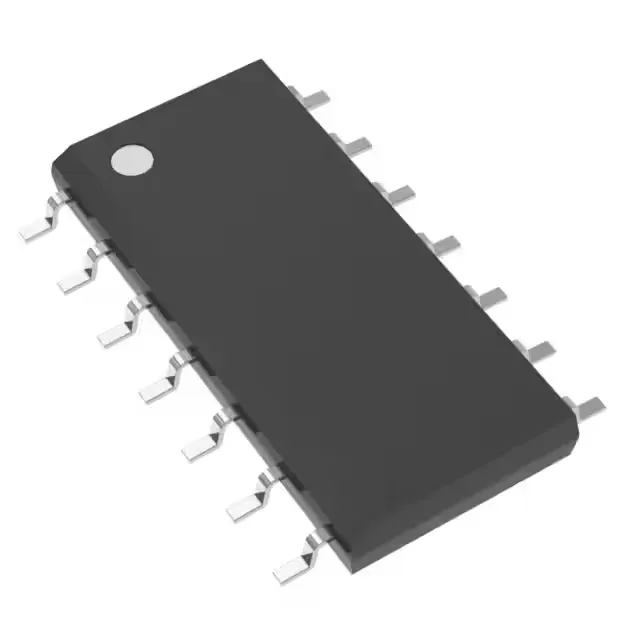
Package and footprint — 14-SOIC narrow body
This is the standard narrow-body SOIC footprint — widely second-sourced, easy to hand-solder or rework.