152 kHz GBW and 0.1 V/µs slew — design for DC, not speed
It is sized for DC and low-frequency signals: temperature sensors, pressure transducers, battery voltage monitoring, and photodiode amplifiers where the signal bandwidth stays below a few kilohertz. The 1.5 mV input offset and 2 nA input bias are typical for a general-purpose bipolar input stage — adequate for many sense paths but not precision metrology.
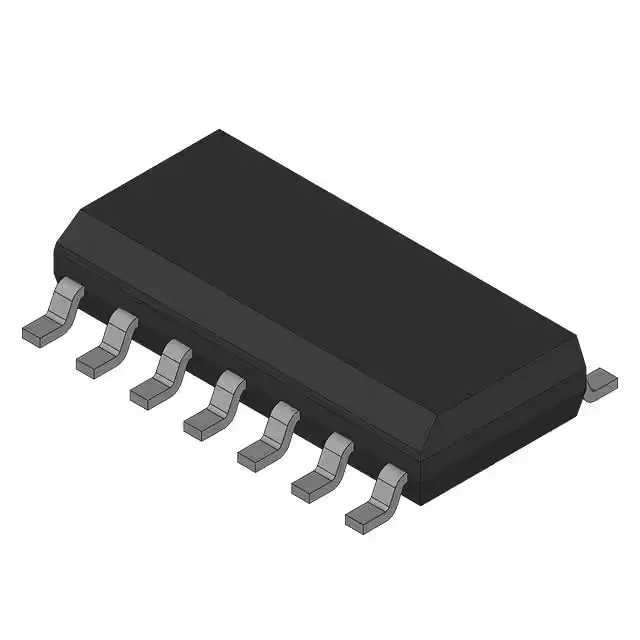
Package and footprint: 14-SOIC, Bulk ship
The actual device case is 14-SOIC, a standard surface-mount footprint shared with many quad op-amps.
RoHS non-compliant — verify your market
However, it is RoHS non-compliant. For designs destined for EU, California, or other RoHS-regulated markets, this part requires an exemption or a plan to qualify a RoHS-compliant alternative. The active lifecycle means supply is stable through franchised and independent channels — no allocation risk, but the RoHS flag is the sourcing gate.
Where it sits against the OPA4374AIPWT
The LPV324M draws 28 µA total versus the OPA4374's 600 µA per channel (2.4 mA total), so the LPV324M wins on quiescent power by roughly two orders of magnitude. The trade-off is speed: the OPA4374 offers 6.5 MHz GBW and 5 V/µs slew rate, versus 152 kHz and 0.1 V/µs for the LPV324M. If your signal chain needs bandwidth above a few kilohertz, the OPA4374 is the better fit; if battery life is the priority, the LPV324M is the right call.