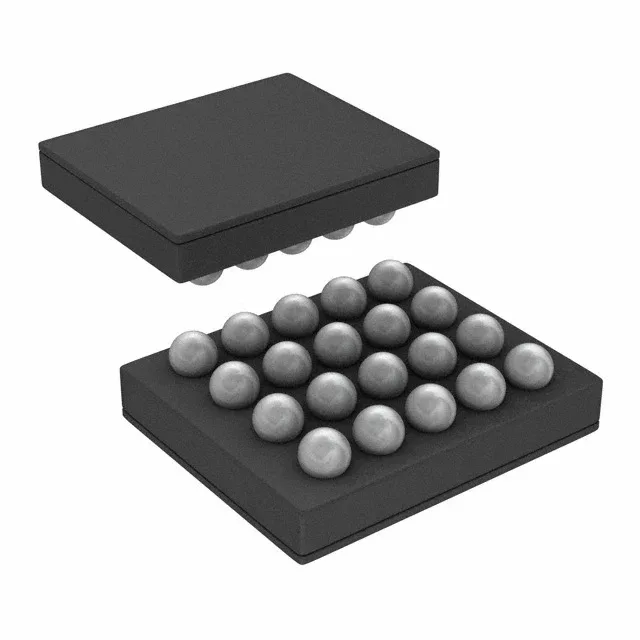
The Texas Instruments LP5521TM/NOPB is a 3-output DC-DC regulator built as a switched-capacitor charge pump, purpose-made for driving backlight LEDs. Unlike an inductor-based boost converter, this topology generates a regulated 4.55 V output using only ceramic capacitors — no magnetic component, which saves board height and eliminates inductor whine. Each of the three channels delivers up to 25.5 mA, controlled individually over an I²C bus for dimming. The 1.25 MHz switching frequency keeps external capacitors small, though the 20-WFBGA package (also called 20-TuSMD) means the board needs a reflow oven and X-ray inspection; this is not a hand-solder field-swap part. The -30°C to 85°C ambient range covers indoor consumer gear like LCD monitor backlights, portable device displays, and appliance panels, but it stops short of automotive cabin or outdoor enclosure temperatures.
Dimming is handled entirely through the I²C interface, not a PWM input pin. That means the host microcontroller needs an I²C peripheral and a few bytes of register-write code to set each channel's brightness independently. No dedicated PWM timer is required, which simplifies the MCU selection, but the firmware must handle the I²C protocol and potentially a register map. The driver does not generate its own PWM waveform on the outputs; the current is set digitally via the bus. For a design already using I²C for other peripherals, this fits cleanly; for a system that only has a spare GPIO, an external I²C bridge or a different driver topology would be needed.
Switched-capacitor topology — the no-inductor trade-off
The charge-pump steps up the input voltage (2.7 V to 5.5 V) to the 4.55 V output using flying capacitors. No inductor means no magnetic field emissions and a simpler PCB layout.