Dropout budget at 1 A — the thermal constraint
The LP38692SD-3.3/NOPB is a fixed 3.3 V output LDO from Texas Instruments rated for 1 A continuous output. The headline dropout of 1 V maximum at 1 A means the input rail must stay above 4.3 V to maintain regulation at full load. This is not a part for high-ripple automotive pre-regulator rails where the input may sag to 3.6 V during cold crank; the LMS1587IS-3.3/NOPB with its lower dropout handles that scenario better.
PSRR — what 55 dB at 120 Hz actually buys you
The 55 dB PSRR at 120 Hz is a classic post-rectifier ripple rejection figure. It attenuates 1 Vp-p of 120 Hz ripple from a full-wave bridge to about 1.8 mVp-p at the output. That is adequate for powering analog front-ends where the ADC reference or op-amp supply needs clean DC, but it does not extend into the switching-regulator band — above a few kilohertz the PSRR rolls off. If your design needs 60 dB+ rejection at 100 kHz, look at the LP5907UVX-3.3/NOPB which holds 90 dB at 100 Hz and 60 dB at 100 kHz.
55 µA quiescent — always-on rail budget
The 55 µA quiescent current (100 µA maximum) keeps the always-on 3.3 V rail from draining the battery in standby. For a microcontroller that sleeps at a few microamps, this LDO adds 55 µA to the sleep budget — acceptable for many industrial and IoT edge nodes, but too high for a coin-cell-powered sensor that must survive a year on a CR2032. The 55 µA Iq is the sum of the internal bias current and the output divider; it does not include the load current.
Package and thermal — the 6-WSON exposed pad
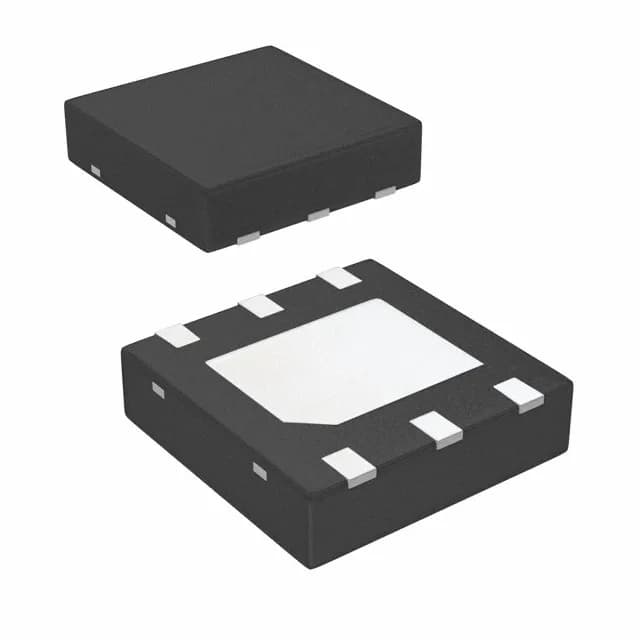
The 6-WSON (3x3 mm) exposed-pad package (supplier device package 6-WSON) is a compact footprint for 1 A capability, but the thermal performance depends entirely on the PCB layout.
The ROHS3 compliance is confirmed.