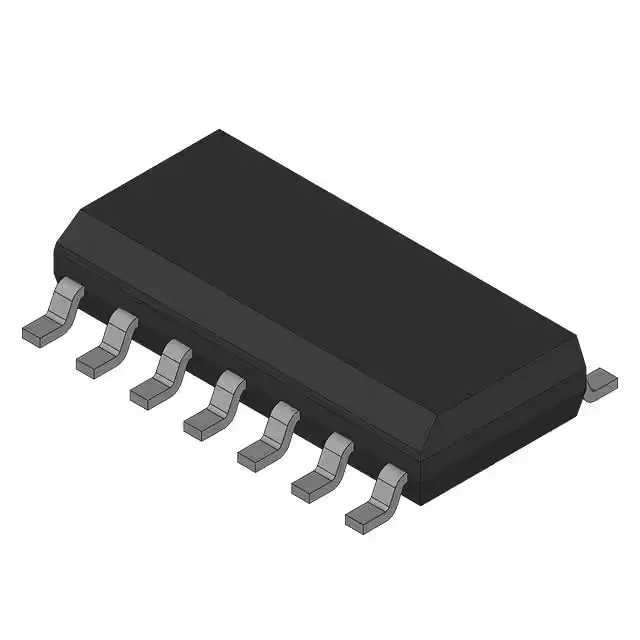
It draws just 85 µA of supply current per amplifier, making it a micropower choice for battery-operated or thermally constrained boards. The gain-bandwidth product is 100 kHz with a slew rate of 0.05 V/µs — this is a low-frequency part, suited for DC signal conditioning, sensor buffers, and audio-band filtering, not for high-speed ADC drivers or fast control loops.
Supply range and single-supply capability
The LP324M operates from a single supply spanning 3 V to 32 V, or a split supply of ±1.5 V to ±16 V. That covers common rails from 3.3 V logic to 24 V industrial buses. The input common-mode range includes ground in single-supply mode, so it can sense signals near the negative rail — useful for low-side current sensing or ground-referenced inputs.
It is not specified for automotive under-hood or industrial extended-temperature applications.
Input offset and bias current — what they mean
For a general-purpose op-amp these are adequate for many sensor and signal-conditioning tasks, but precision DC applications (e.g., microvolt-level measurements) would want a lower-offset amplifier.
It is RoHS non-compliant (lead-bearing), so check your assembly line's exemption status if you are shipping to RoHS-regulated markets.