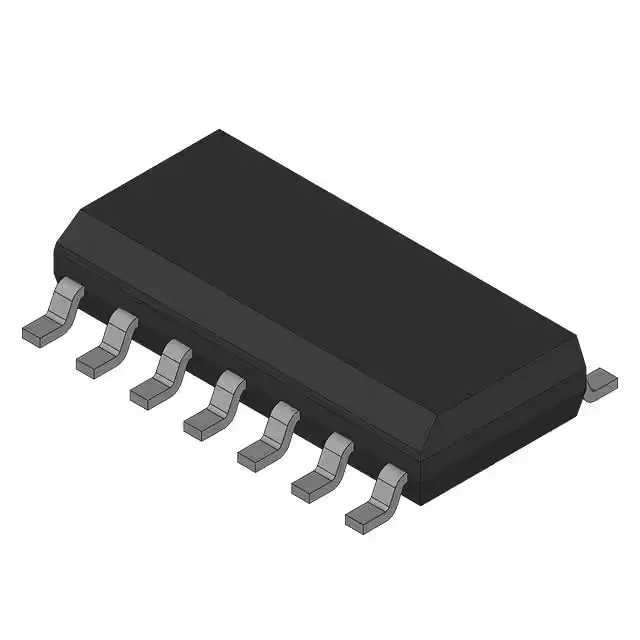
100 kHz GBW and 85 µA — the low-power trade-off
With a gain-bandwidth product of 100 kHz and total supply current of 85 µA across all four amplifiers, it fits applications where the signal frequency stays below a few kilohertz and every microamp on the rail is budgeted — battery-monitor front-ends, thermocouple conditioning, and always-on sensor interfaces in industrial control or portable instruments. The 2 mV input offset and 2 nA input bias are typical for a bipolar-input design at this power level; they are adequate for DC-accurate loops but not precision measurement without a trim.
The supply span from 3 V minimum to 26 V maximum means the same LP2902M can serve a 3.3 V microcontroller board and a 24 V industrial sensor module. No need to qualify a separate low-voltage and high-voltage op-amp — the quad channel count (four circuits in one 14-SOIC) further consolidates the BOM. The 10 mA per-channel output current is enough to drive a following ADC input or a logic gate, but not a relay or heavy load.
Industrial temperature band and active lifecycle
Note that the RoHS status is listed as non-compliant, so verify your assembly's regulatory requirements if this is a new qualification.
A slew rate of 0.05 V/µs limits the large-signal bandwidth to roughly 800 Hz at 10 V output swing. For a 1 V peak-to-peak signal the full-power bandwidth extends to about 8 kHz.