For a general-purpose amplifier those numbers are clean enough that most designs won't need an external trim pot or a servo loop. If you're doing a precision DC measurement — say a thermocouple amplifier or a current-sense circuit with a shunt — the 30 µV offset contributes about 0.03% error on a 100 mV full-scale signal, which is acceptable for a lot of industrial and consumer applications. The 70 nA bias current matters if your source impedance is high; with a 100 kΩ source that bias drops 7 mV across the resistance, which may or may not be in your error budget. For low-impedance signals (under 10 kΩ) it's negligible.
The LMV641MF/NOPB operates from a single supply spanning 2.7 V to 12 V, covering common 3.3 V, 5 V, and 12 V rails without needing a split supply. That simplifies the power architecture in mixed-voltage designs. Keep an eye on the package dissipation in the SOT-23-5 when driving heavy loads continuously — at 12 V and 112 mA the internal power can exceed the package's thermal capability if you don't derate.
The 125°C upper limit means it can sit next to a power supply or a motor driver without needing a separate cool zone on the board. No commercial-grade variant exists — every LMV641MF/NOPB ships with the full temperature range, so there's no BOM split risk.
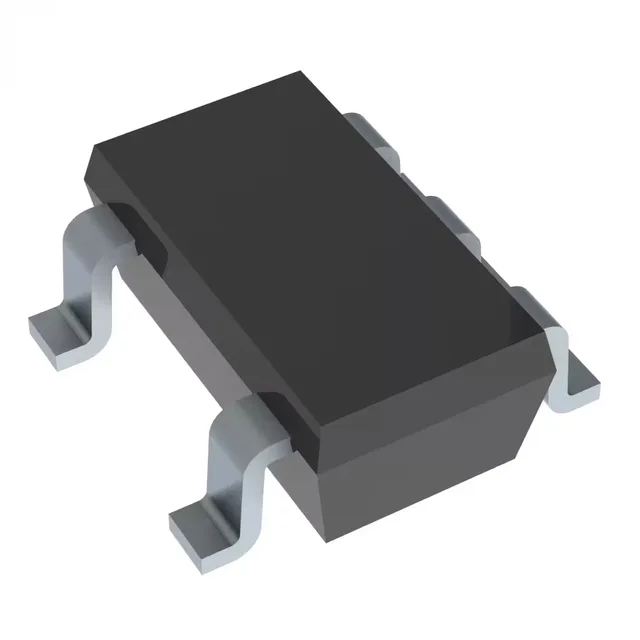
Package and footprint — SOT-23-5, easy to hand-solder
Housed in a SOT-23-5 (SC-74A) package, the LMV641MF/NOPB uses a standard 5-pin footprint with 0.95 mm pitch. The marking is legible under a loupe, which helps during rework or field repair.
The NOPB suffix confirms lead-free (RoHS) construction, which is standard for new builds.