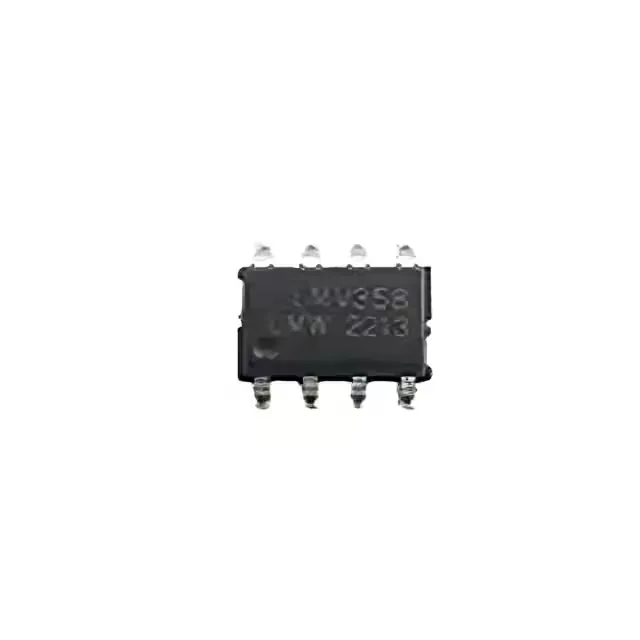
The 2.7 V minimum supply lets this part run directly from a 3.3 V rail with headroom to spare, while the 5.5 V maximum covers 5 V logic and sensor supplies. Each channel draws 210 µA of quiescent supply current, totaling 420 µA for both amplifiers. That is low enough for battery-backed systems but not the lowest in TI's portfolio — if every microamp counts, look at the nanopower family. The 40 mA output current per channel drives moderate loads like ADC inputs or small relays directly.
Bandwidth and input offset — where the 1 MHz GBW fits
At 1 MHz gain-bandwidth, the LMV358IDR supports closed-loop gains up to about 100 at 10 kHz, or unity-gain buffers up to 1 MHz.