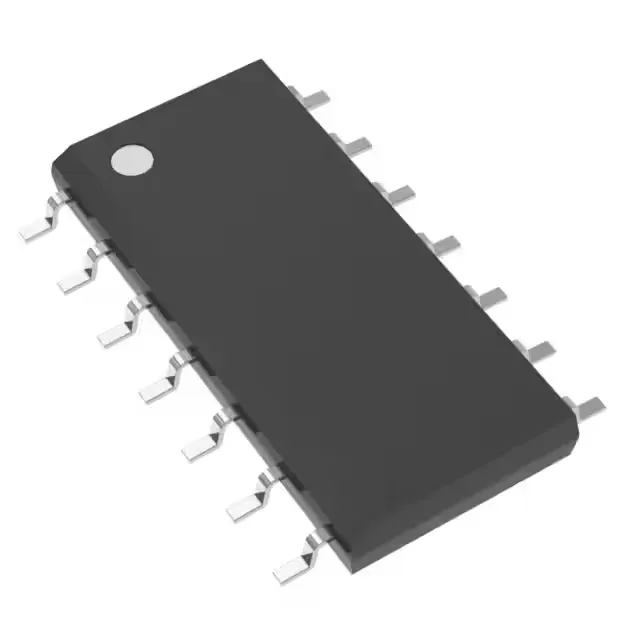
What this quad op-amp does on your board
The Texas Instruments LMV324MX/NOPB is a quad-channel general-purpose operational amplifier in the LMV® series, packaged in a 14-SOIC.
Supply rails and output swing — the practical limits
The rail-to-rail output stage means the signal can swing within millivolts of each supply rail, which matters when you are digitising a sensor output near ground or driving an ADC reference input. Input common-mode range is not rail-to-rail on this part — it extends from the negative rail to about 1 V below the positive rail — so high-side current sensing at 3.3 V single supply is not a natural fit; keep the input signals within that window.
Speed and drive capability
With a 1 MHz gain-bandwidth product and 1 V/µs slew rate, this op-amp handles audio-frequency filtering, slow sensor amplification, and control-loop conditioning. It is not built for video or high-speed data acquisition.
Input offset and bias — what to expect in production
For a general-purpose amplifier these numbers are typical; they do not limit precision measurement below a few millivolts. If your application requires sub-millivolt accuracy, a precision op-amp with lower offset and bias would be the better choice. The 15 nA bias current matters when the source impedance is high — a 100 kΩ source sees a 1.5 mV drop from bias alone.
It is a current-production part, not a last-time-buy or NRND item.