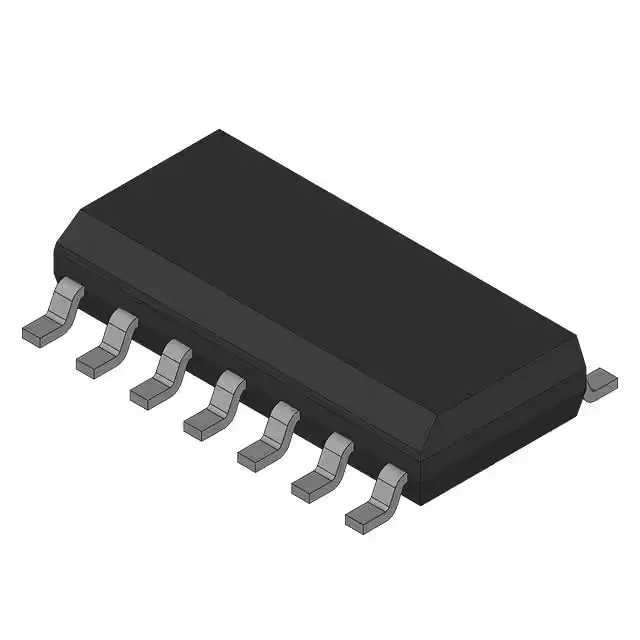
It packs four independent amplifiers into a 14-SOIC package, each offering a 1 MHz gain-bandwidth product and a 1 V/µs slew rate — enough for sensor buffering, signal conditioning, and low-speed control loops in engine-control units, body controllers, and industrial sensor modules.
For a production BOM this is the difference between a part that can go into a PPAP submission and one that cannot.
Key ratings and their design implications
Each of the four amplifiers draws 410 µA of supply current, so the total quiescent draw for the package is about 1.6 mA — low enough for always-on sensor interfaces in battery-backed modules. The 160 mA output current per channel is unusually high for a general-purpose op-amp; it can directly drive a small relay coil or a piezo buzzer without a separate buffer transistor. Input offset voltage is specified at 1.7 mV typical, which is adequate for 8-bit-level accuracy but not for precision weigh-scale or current-sense applications — those would need an auto-zero or chopper-stabilized amplifier. The 15 nA input bias current is typical for a bipolar-input stage; if your source impedance is above 100 kΩ, consider a CMOS-input alternative to avoid offset drift from bias current.
Package and footprint notes
The supplier device package is 14-SOIC, and the listing shows the shipping medium as Bulk — tubes or trays, not tape-and-reel. If your pick-and-place line expects tape-and-reel, confirm the packaging variant before ordering. The SOIC-14 footprint is standard; no thermal pad is needed at the quiescent current levels this part draws.
