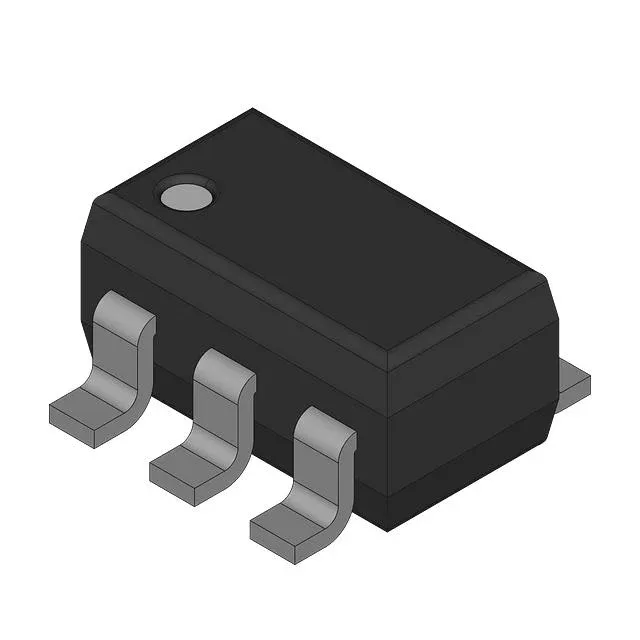
It delivers a 35 V/µs slew rate and 45 MHz -3 dB bandwidth while drawing only 600 µA of supply current — a combination that places it in the high-speed, low-power niche between general-purpose op-amps and full video amplifiers. The rail-to-rail push-pull output stage lets it swing close to the supply rails, useful when driving an ADC input or a single-supply signal chain without a negative rail.
35 V/µs slew rate at 600 µA — the trade-off that defines this part
The headline number is the slew rate: 35 V/µs. For a voltage-feedback amplifier drawing 600 µA quiescent current, that is fast — enough to handle a 5 MHz full-scale sine wave without slewing into distortion, or to settle a 10 V step in under 300 ns. The trade-off appears in the input bias current (400 nA) and input offset voltage (1 mV), which are higher than a precision CMOS op-amp would deliver. This part is not for microvolt-level sensor conditioning; it is for signal paths where speed matters more than DC accuracy — ADC drivers, video buffers, timing circuits, and high-speed filter stages. The 20 mA output current per channel is adequate to drive a 50 Ω load to about 1 Vpp, but for a full 2 Vpp into 50 Ω you would need a post-amplifier or a higher-current driver.
No official second-source cross-reference is published by TI, but the TLV9351IDCKR (3.5 MHz, 20 V/µs, 10 pA input bias) is a functionally similar voltage-feedback op-amp in the same SOT-23-6 footprint if you need a dual-source option — though the TLV9351 is slower and draws less bias current, so check the speed requirement before substituting.