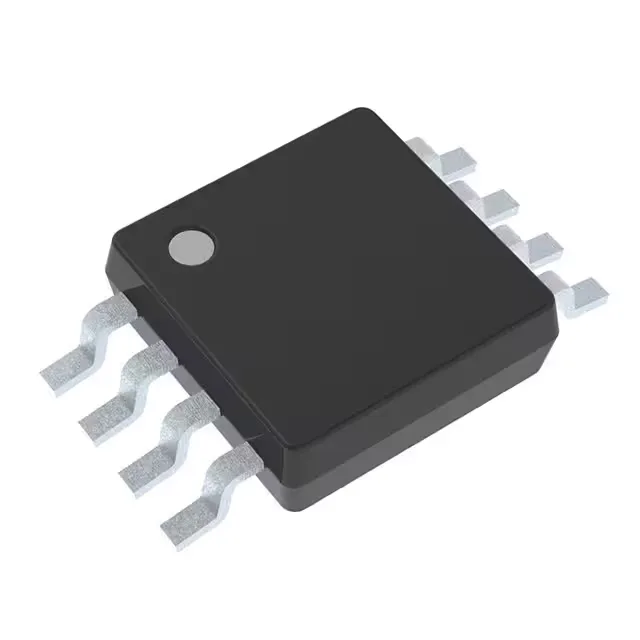
Micropower dual op-amp for precision sensor conditioning
The output swings rail-to-rail, and the supply range from 1.6 V to 5.5 V covers both 1.8 V and 3.3 V logic rails.
The 130 kHz gain-bandwidth product sets the usable closed-loop bandwidth. For a gain of 100, the -3 dB point is about 1.3 kHz — adequate for slow sensor signals like temperature, pressure, or strain, but not for audio or fast data acquisition. The 10 µV typical input offset voltage is the key precision spec: it determines the DC error at the output without calibration. In a thermocouple amplifier with a gain of 1000, a 10 µV offset translates to 10 mV at the output, which is acceptable for many industrial process-control loops. The 0.02 pA input bias current means negligible voltage drop across high source resistances — a 1 MΩ source adds only 20 nV of offset error.
19 µA supply — sizing the power budget
At 19 µA per amplifier (38 µA total for both channels), the LMP2232AMMX/NOPB fits into designs where every microamp counts. A 3.7 V Li-ion battery powering this op-amp continuously would see a drain of roughly 0.14 mW — negligible in a system with a wireless transmitter that draws tens of milliamps during bursts.
The LMP2232AMMX/NOPB is supplied in an 8-VSSOP package (also described as 8-TSSOP or 8-MSOP with 0.118-inch, 3.00 mm width). It is a surface-mount device, intended for reflow soldering on standard FR-4 PCBs. The small footprint suits space-constrained designs such as sensor modules or portable probes.