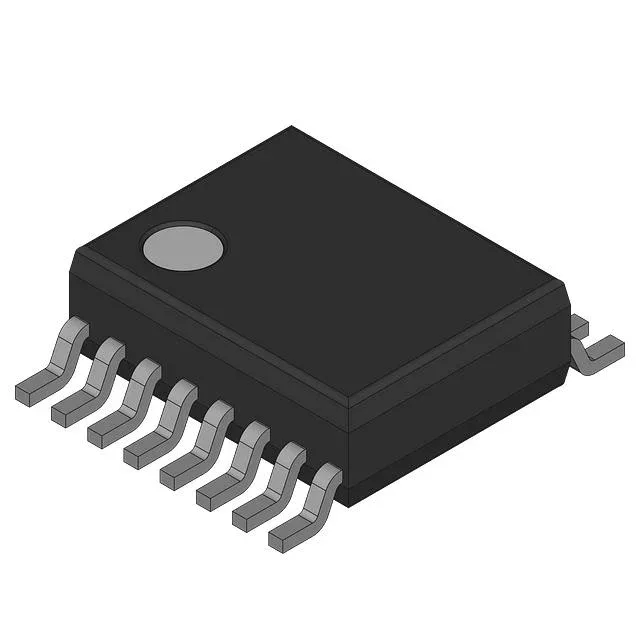
The Texas Instruments LMH6739MQ is a three-channel video amplifier configured as a buffer, delivering a 750 MHz -3dB bandwidth and a 3300 V/µs slew rate. That combination makes it suited for high-resolution video distribution, cable driving, and fast pulse amplification where signal integrity matters up into the UHF range. The three independent circuits share a common supply, so a single 8V to 12V rail (or ±4V to ±6V split supply) powers all channels.
3300 V/µs is an order of magnitude faster than a general-purpose op-amp. For a video buffer, that means the output can swing several volts in a nanosecond, preserving the sharp edges of fast video sync pulses or high-frequency analog waveforms. If the load capacitance or cable length starts to roll off the edge rate, this part keeps the signal clean without extra external compensation.
Supply rails and output drive
The supply range of 8V to 12V single (or ±4V to ±6V dual) gives you flexibility: a single 12V rail works for most composite-video or RGB applications, while a ±5V split supply keeps the output centered around ground for AC-coupled systems.
Lifecycle and RoHS status
However, it is listed as RoHS non-compliant — it contains lead (Pb) above the threshold. That rules it out for EU RoHS-required builds unless you have an exemption, but it remains fully available for military, aerospace, or industrial designs where leaded solder is still permitted or preferred for reliability reasons.