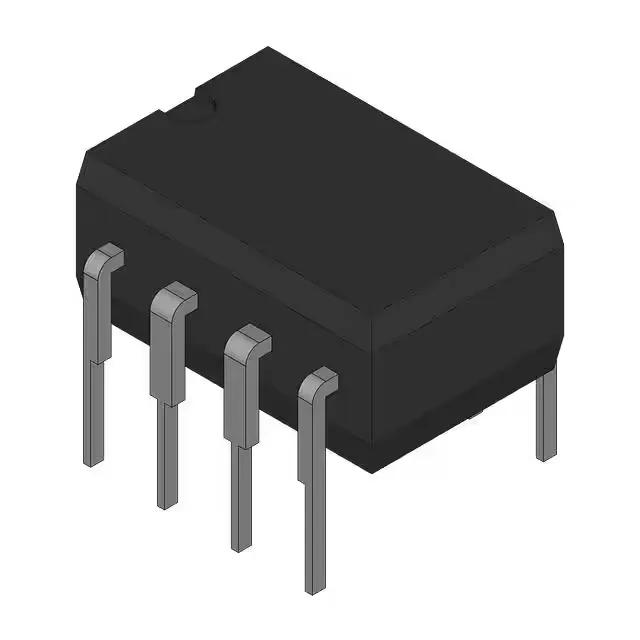
Dual CMOS op-amp in a through-hole DIP-8
It delivers a 1.4 MHz gain-bandwidth product and a 1.1V/µs slew rate, with push-pull rail-to-rail output that swings within millivolts of the supply rails — useful for single-supply signal chains where every bit of headroom matters. The 0.002 pA typical input bias current is the standout spec here: it lets you interface directly with high-impedance sources like photodiode detectors, pH probes, or piezoelectric sensors without loading the signal or adding a noticeable offset error. Supply range spans 4.75 V to 15.5 V single or dual supply, and each channel draws 750 µA quiescent current. The 8-DIP body is a legacy through-hole footprint — still common in lab instrumentation, breadboard prototyping, and retrofit repairs on older PCB designs where a surface-mount respin isn't justified.
Input bias current — why it matters for sensor front-ends
At 0.002 pA typical, the input bias current is orders of magnitude lower than a general-purpose bipolar op-amp (which runs tens to hundreds of nA). That means the LMC662CN/NOPB adds negligible DC error when buffering a high-impedance source. For a 1 MΩ source impedance, the offset voltage contribution from bias current is roughly 2 nV — effectively zero in any practical circuit. The trade-off is speed: the 1.4 MHz GBW and 1.1V/µs slew rate limit this part to audio-frequency or low-speed instrumentation paths. If you need faster settling for a switched-capacitor ADC driver, the TLV9362IDDFR (10.6 MHz, 25 V/µs) is a surface-mount alternative in the same rail-to-rail CMOS class, but it trades the through-hole DIP for a small DFN package and draws 2.6 mA per channel.