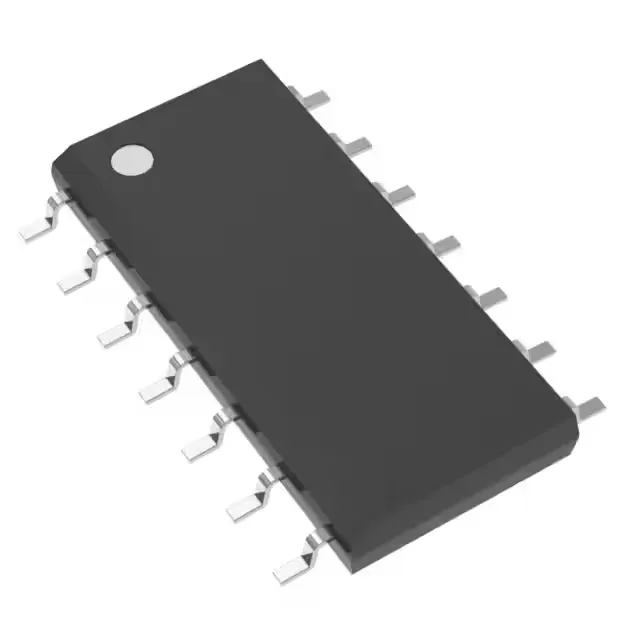
What this quad op-amp is for
The Texas Instruments LMC6044IMX/NOPB is a CMOS quad operational amplifier — four independent op-amps in a single 14-SOIC package. Its 100 kHz gain-bandwidth product and 0.02 V/µs slew rate place it squarely in the low-frequency signal-conditioning space: sensor buffers, photodiode amplifiers, thermocouple front-ends, and battery-monitor circuits where bandwidth is traded for micropower operation. Rail-to-rail push-pull output lets it swing to the supply rails without an extra headroom penalty.
100 kHz GBW and 0.02 V/µs slew — the speed trade-off
The 100 kHz gain-bandwidth and 0.02 V/µs slew rate are the speed ceiling. It is sized for DC and near-DC signals: a 10 Hz thermocouple amplifier, a 1 kHz strain-gauge bridge, or a low-pass filter with a corner below 10 kHz. The 40 mA per-channel output current can drive a modest ADC input or a meter movement, but not a headphone or relay coil directly.
0.002 pA input bias — the real differentiator
The 0.002 pA typical input bias current is the spec that sets this part apart from general-purpose op-amps. With CMOS inputs, the bias is essentially the gate leakage of the input FETs. That lets you use 10 MΩ or higher feedback resistors without offset errors dominating the output. For a photodiode transimpedance amplifier or a pH probe buffer, this part keeps the DC error in the microvolt range where a bipolar-input op-amp would add millivolts. The 1 mV input offset voltage is the other side: it is typical for CMOS, not precision, so if you need sub-100 µV offset, look at an auto-zero amplifier instead.
The 4.5 V to 15.5 V supply span covers single 5 V, single 12 V, and dual ±5 V rails. The 4.5 V minimum means it will not run on a 3.3 V rail — if your board is 3.3 V only, this part needs a boost regulator or you pick a different op-amp. The 14-SOIC package is a standard footprint, easy to hand-solder or reflow.