50 MHz Cortex-M3 with Ethernet — what this MCU brings to a BOM
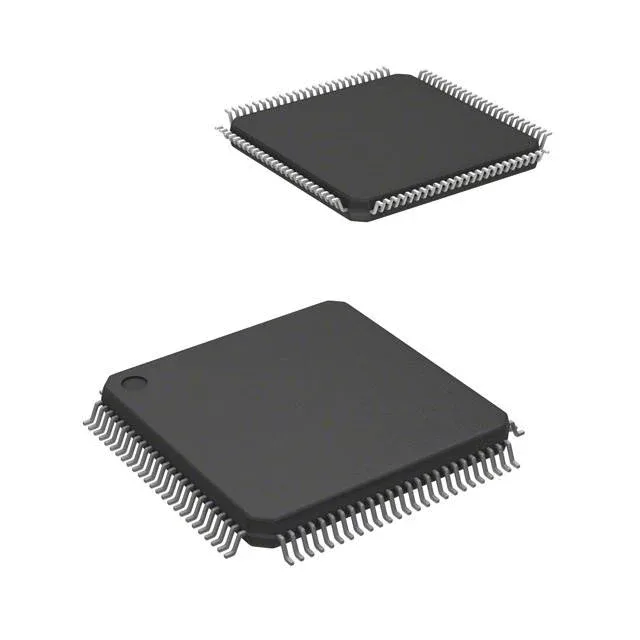
The Texas Instruments LM3S6618-EQC50-A2 is a 32-bit ARM Cortex-M3 microcontroller from the Stellaris 6000 series, clocked at 50 MHz with 128 KB of Flash program memory and 32 KB of SRAM. It integrates an Ethernet MAC controller alongside a full suite of serial interfaces — I²C, SPI, SSI, UART/USART, IrDA, and Microwire — making it a fit for industrial control nodes, building automation gateways, and networked sensor concentrators that need a single-chip protocol bridge without an external PHY (the MAC is on-chip; the PHY interface is external). The part is rated for -40 to 105 °C operation, covering factory-floor and outdoor enclosure environments. On-chip peripherals include brown-out detect, POR, PWM, and a watchdog timer, plus an 8-channel 10-bit ADC for analog feedback from sensors or potentiometers. The 38 general-purpose I/O lines in a 100-pin LQFP package give enough headroom for a parallel LCD interface or a bank of optocoupled inputs alongside the serial buses.
Obsolete — sourcing reality for the LM3S6618-EQC50-A2
This part is officially obsolete per the manufacturer's lifecycle status. No last-time-buy window remains open; production has ended. For BOM lines that require this exact order code — whether for a legacy board repair, a field retrofit, or a design that cannot migrate — the only channel is the independent surplus and broker market. No manufacturer-declared direct replacement or pin-compatible successor exists for the LM3S6618-EQC50-A2 within the Stellaris family. Any cross-reference or equivalent must be evaluated on a form-fit-function basis by the design team, considering the 50 MHz core, 128 KB Flash / 32 KB SRAM, Ethernet MAC, and 100-LQFP footprint. A migration to a current-production Cortex-M3 or Cortex-M4 part from another series or vendor will likely require a PCB respin and software port.
Supply voltage and temperature range
Core and I/O share a single 2.25 V to 2.75 V supply rail. The -40 to 105 °C rating covers industrial and automotive cabin environments; the internal oscillator eliminates the need for an external crystal in non-precision timing applications.
