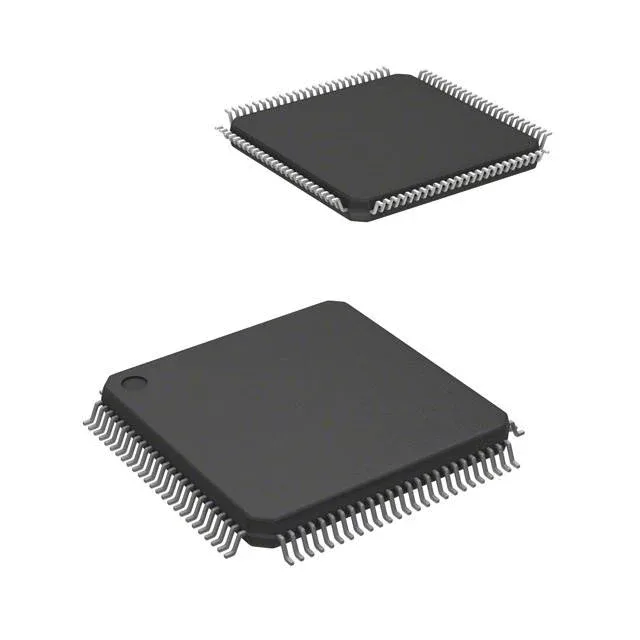
The 50 MHz clock rate on this Cortex-M3 core is enough for single-loop PID updates at several kilohertz, Modbus RTU packet handling, and basic sensor fusion. It is not a high-end number — you would not use it for gigabit Ethernet bridging or real-time FFT on large arrays — but for a dedicated control MCU on a motor drive or a remote I/O slice, 50 MHz with zero-wait-state Flash access keeps the bus margin comfortable.
128 KB Flash and 20 KB RAM — sizing the firmware
128 KB of Flash holds a moderate application: a bootloader, a real-time kernel, communication stacks for two or three protocols, and the application code. The 20 KB of SRAM leaves room for a few hundred bytes of stack per task plus a data buffer for ADC samples or UART FIFOs. If your BOM calls for more than 20 KB of runtime data, this part will force external SRAM or a memory-map reshuffle.
The LM3S1J11-IQC50-C3 is marked obsolete by Texas Instruments. No last-time-buy window remains open through the factory channel.
Peripherals and I/O — what is on the pins
The 67 GPIOs are multiplexed with the serial interfaces and the PWM outputs. The part includes a brown-out detect and reset circuit, a DMA controller, a POR monitor, PWM generation, and a watchdog timer. An internal oscillator is available, so a crystal is optional for applications that can tolerate the internal accuracy. The 10-bit ADC has eight channels — enough for reading potentiometers, current-sense resistors, or thermistor dividers without an external mux.