Fixed 1.6V rail from a 2.7V–5.5V input
The Texas Instruments LM3671MF-1.6 is a synchronous buck regulator that delivers a fixed 1.6V output at up to 600mA from an input range of 2.7V to 5.5V. The 2MHz switching frequency lets you use small 1µH–2.2µH inductors and low-ESR ceramic capacitors, shrinking the total solution footprint. Internal synchronous rectifier means no external Schottky diode is needed — just the inductor, input/output caps, and you have a clean 1.6V rail.
600mA output — load budget check
The 600mA current rating is the continuous output capability. If your target circuit draws 500mA steady-state with 100mA peaks, this part has headroom. But if you need 800mA or more, step up to a higher-current buck like the LMR33630 (3A) or LMS3655 (5.5A). At light loads (below ~50mA), the part still regulates, but efficiency drops — consider a PFM-mode part if your design spends most time in low-power sleep.
2MHz switching — inductor and cap sizing
At 2MHz, the ripple current is low enough that a 2.2µH inductor and 10µF ceramic output cap give a clean rail. That frequency also keeps switching noise above the AM radio band, which helps in RF-sensitive designs. The trade-off: switching losses at 2MHz are higher than a 500kHz part, so expect around 85–90% efficiency at full load — fine for most battery-powered or 5V-bus applications.
The synchronous rectifier helps maintain efficiency across the temperature range. If you need 125°C or 150°C operation, look at the automotive-grade peers (LM53625, LMR33630) — those are AEC-Q100 qualified and rated to 125°C or 150°C junction.
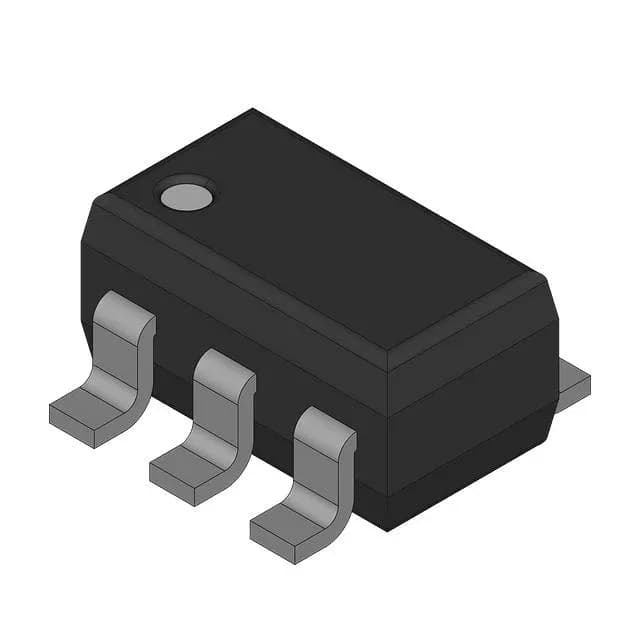
SOT-23-5 package — layout notes
The LM3671MF-1.6 comes in an SOT-23-5 (SC-74A) package. The small footprint saves board space, but thermal dissipation is limited — the junction-to-ambient thermal resistance is around 220°C/W, so at 600mA output with 1V dropout (5V in, 1.6V out), expect about 2W dissipation, which will push junction temperature above 85°C in still air. For high-current or high-ambient designs, add a copper pour on the PCB or use the exposed-pad variant (if available).