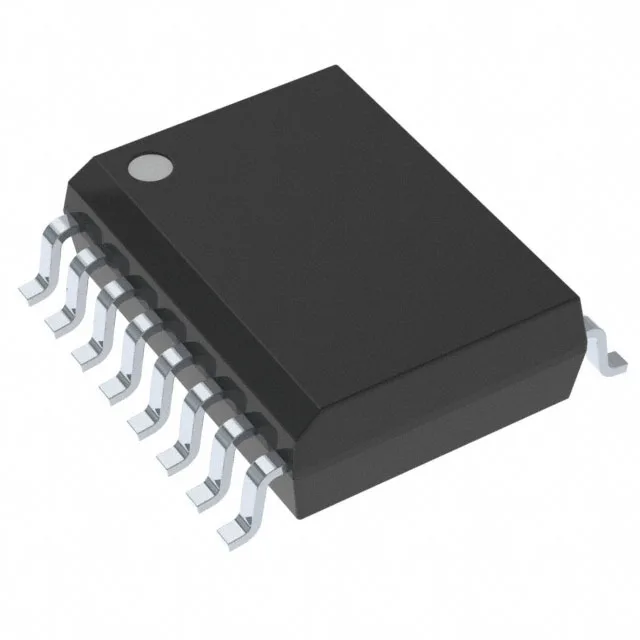
That isolation rating, combined with a minimum common-mode transient immunity of 100 kV/µs, makes it a strong fit for motor drives, industrial inverters, and power-supply feedback paths where fast-switching edges (IGBTs, SiC, GaN) would otherwise corrupt data or latch up a standard optocoupler. The 100 Mbps data rate handles SPI, UART, and general-purpose logic-level isolation without timing margin issues — propagation delay is a symmetrical 16 ns max for both low-to-high and high-to-low transitions, with pulse-width distortion held to 4.6 ns max.
Supply range and channel direction — check the BOM fit
The supply range spans 2.25 V to 5.5 V on both sides, so the part can bridge a 3.3 V controller domain to a 5 V sensor or actuator rail without an external level shifter. Note the channel configuration: two inputs on side 1, zero on side 2 (2/0). This is a forward-only isolator — all data flows from side 1 to side 2. If you need bidirectional communication or a transceiver function, this is not the part; look at the ISO7721 family (1/1 channel split) instead.
No official second-source alternate is listed, but the ISO7830DWWR (three-channel, same isolation and data rate) shares the same 16-SOIC footprint and supply range if you need an extra channel in a future spin.