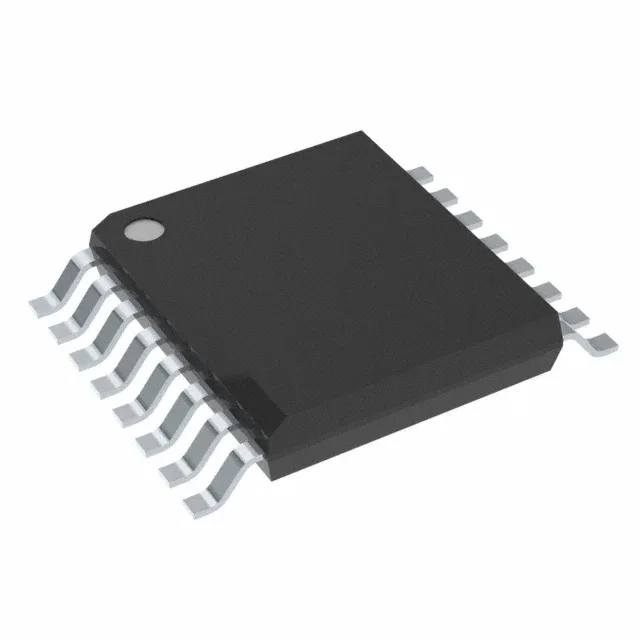
Quad-channel digital isolator for noisy industrial buses
It is designed for applications where galvanic isolation is required between communication interfaces — think isolated SPI, UART, RS-485, or CAN buses in motor drives, grid-tied inverters, PLC I/O modules, and medical equipment. The 4-channel unidirectional configuration (3 channels on side 1, 1 channel on side 2) suits the typical data/clock/select plus one feedback signal arrangement.
100 Mbps data rate — timing budget for SPI and UART
At 100 Mbps the ISO7741DBQ handles 50 MHz SPI clocks cleanly, with a typical propagation delay of 16 ns and pulse-width distortion held to 4.9 ns max. The 2.4 ns rise/fall times keep the eye open across a short backplane trace, but the fast edges also mean you want to keep the output trace short or add a small series resistor to damp ringing — especially if the load is a high-impedance CMOS input on the other side of the barrier.
85 kV/µs CMTI — surviving the switching node
Fast SiC or GaN switching edges can inject several kV/µs across the barrier; if the isolator's CMTI is too low, the output glitches and the power stage sees a spurious on/off command. At 85 kV/µs this part has margin for most IGBT and SiC designs up to the 10-20 kV/µs range that appears in hard-switched converters.
Supply range and dual-voltage operation
The supply range spans 2.25 V to 5.5 V on both sides, which means you can run the input side at 3.3 V and the output side at 5.0 V without a level shifter — useful when isolating a 3.3 V MCU from a 5 V peripheral bus. The part does not include an integrated DC-DC converter, so each side needs its own isolated power rail (e.g., a transformer-coupled push-pull or an isolated module).
For production BOMs this is a low-risk line item — no urgency to qualify a drop-in replacement.