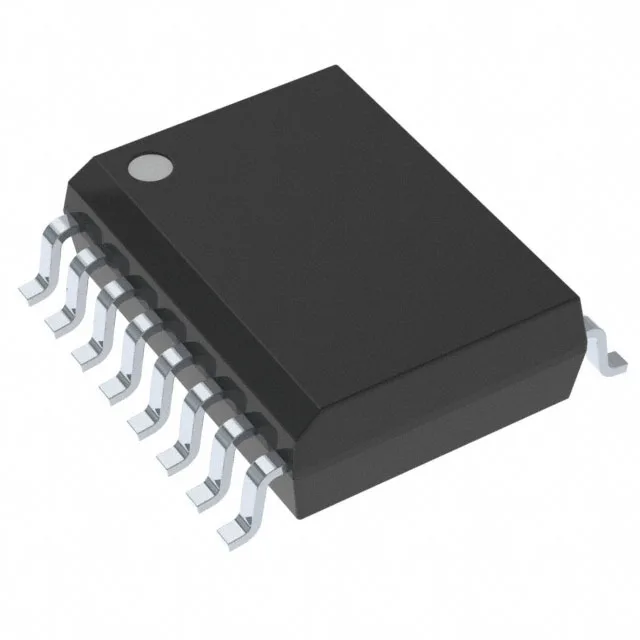
Its 5000Vrms isolation voltage and 85kV/µs common-mode transient immunity make it a candidate for galvanic isolation in traction inverter gate drives, on-board charger communication, and battery-management-system SPI links where fast switching edges from SiC or GaN power stages demand high CMTI. The 100Mbps data rate keeps up with CAN FD and isolated SPI without adding bus-turnaround delay. Supply range of 2.25V to 5.5V on both sides lets it interface directly with 3.3V and 5V logic domains without external level shifters.
Common-mode transient immunity of 85 kV/µs (minimum) means this isolator maintains data integrity when a 1.5 kV common-mode step slews at tens of kilovolts per microsecond — exactly what happens across the isolation barrier in a half-bridge gate drive during hard switching. If your power stage uses wide-bandgap devices, the 85 kV/µs floor keeps the receiver from latching or outputting a false edge. The propagation delay is symmetrical at 16 ns max (tpLH and tpHL), and pulse-width distortion stays under 4.9 ns, so the duty cycle of a PWM signal is preserved within a few nanoseconds across the barrier.
That puts it in the tier for under-hood electronics, transmission control, and chassis-domain modules where the ambient can exceed 105°C. The channel configuration is 2 inputs on side 1 and 1 input on side 2 — a 2/1 split that suits a typical SPI isolation pattern (SCLK, MOSI in one direction, MISO in the other).