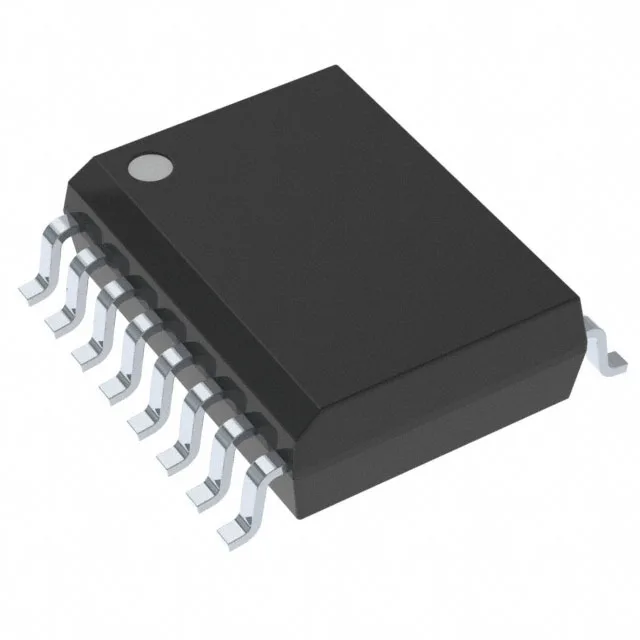
It delivers 2500 Vrms isolation in a 16-SOIC wide-body package, with three channels on side 1 and one reversed channel on side 2 — a 3/1 unidirectional configuration that suits split-supply interfaces where the main data flow is one direction and a single feedback or enable line runs the other way.
At 25 Mbps the ISO7241CDWR handles most fieldbus interfaces (CAN, RS-485 at 1–10 Mbps), SPI at moderate clock rates, and general-purpose GPIO isolation. The 42 ns max propagation delay in either direction (tpLH / tpHL) adds about 84 ns round-trip for a handshake signal — budget that into your timing closure if the loop goes through the isolator twice. The 2.5 ns max pulse-width distortion keeps the mark-space ratio close to 50 %, which matters for PWM signals or clock recovery where duty-cycle accuracy affects the downstream logic.
Isolation specs that drive the BOM decision
The 2500 Vrms isolation rating is the reinforced-safety figure for mains-isolated circuits in industrial PSUs, motor drives, and medical equipment where the barrier must withstand a 60-second hipot test. The 25 kV/µs minimum common-mode transient immunity (CMTI) is the spec that separates a reliable design from one that glitches on every IGBT switching edge — in a motor-drive inverter with 600 V bus voltage and 50 ns rise times, the dV/dt across the barrier can easily exceed 10 kV/µs, and the ISO7241CDWR's 25 kV/µs floor gives real margin.