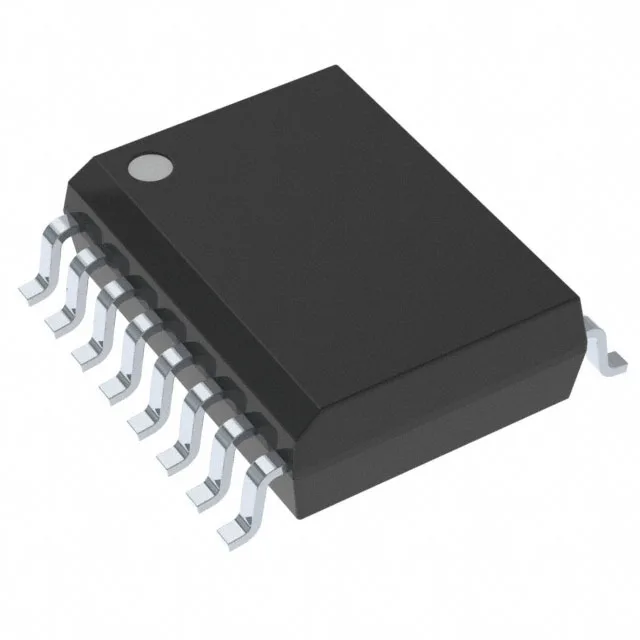
What makes this isolator different from a standard commercial-grade part
For a BOM going into an ECU, motor controller, or battery-management system, that qualification is the difference between a part that survives 15 years under-hood and one that doesn't.
4000Vpk isolation — what it covers and what it doesn't
Rated at 4000Vpk, this part meets reinforced isolation requirements for many automotive and industrial systems. Note that this isolator does not include an integrated DC-DC converter — the isolated power rail must be supplied externally. For designs that need both signal and power isolation in one package, that means a separate isolated module or a different part number.
25 Mbps and 25 kV/µs — the real-world limits
Data rate is 25 Mbps, which comfortably handles SPI clock rates up to that speed, CAN FD at 5 Mbps, or general-purpose GPIO isolation. The common-mode transient immunity is 25 kV/µs minimum — that's the spec that matters when you put this isolator between a microcontroller and a motor-drive power stage. Fast-switching SiC or GaN FETs can generate common-mode voltage spikes that exceed that rate; if your switching edges are faster than 25 kV/µs, you need to check the margin or add external filtering. Propagation delay is 45 ns max each direction, and pulse-width distortion is 5 ns max — tight enough for most control loops but worth budgeting in a timing-critical feedback path.
Supply voltage spans 3.15 V to 5.5 V on each side, so it can bridge a 3.3 V MCU domain to a 5 V sensor or actuator rail without a level shifter. The 4 channels are all unidirectional from side 1 to side 2 — there are no bidirectional or reverse-direction channels, so plan your signal direction accordingly.