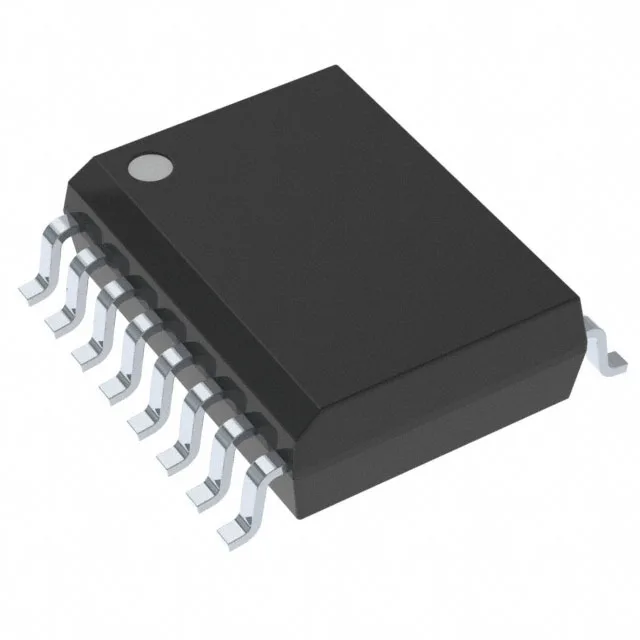
25 Mbps capacitive-coupled isolator with 42 ns propagation delay
The Texas Instruments ISO7240CFDW is a 4-channel, unidirectional digital isolator using capacitive coupling technology, rated for 2500 Vrms isolation and a 25 Mbps data rate. Maximum propagation delay is 42 ns in both directions, with 2.5 ns pulse-width distortion and 2 ns typical rise/fall times.
What the 42 ns propagation delay means for bus timing
At 25 Mbps the bit period is 40 ns, so a 42 ns propagation delay leaves essentially zero timing margin for a single-ended round-trip. This part is sized for unidirectional data paths — SPI clock and MOSI from controller to peripheral, for instance — where the total loop delay (driver + isolator + receiver) must close within one clock cycle. The 2.5 ns pulse-width distortion keeps duty-cycle skew tight enough for most synchronous interfaces at this speed. For bidirectional buses like I²C you'd need a different channel configuration.
25 kV/µs CMTI — why it matters for motor drives and inverters
The minimum common-mode transient immunity of 25 kV/µs means this isolator can reject fast voltage transients across the isolation barrier that would otherwise corrupt data. In a motor-drive or inverter application where the switching node slews at 10–20 kV/µs, that margin keeps the output from glitching. The capacitive coupling technology inherently handles these edges better than optocouplers at this speed, which is the main reason to pick this part over an older opto-based isolator for a 25 Mbps industrial link.
It is a current-production Texas Instruments part, suitable for both new design-ins and ongoing production. The base product number ISO7240 covers a family of speed and channel-configuration variants, so if a future revision needs a different data rate or directionality, the footprint stays the same across the family.