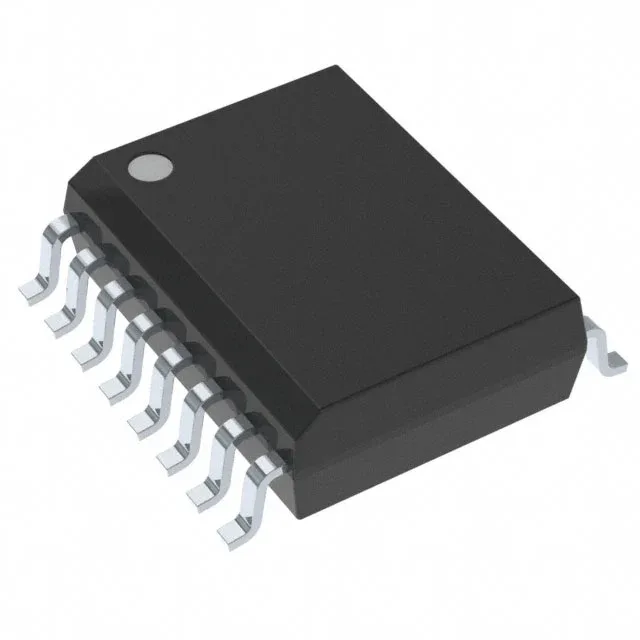
What the ISO1644DWR does on the board
The Texas Instruments ISO1644DWR is a 5-channel digital isolator using capacitive coupling to pass I²C and SPI signals across a galvanic isolation barrier rated for 5000Vrms. It handles bidirectional data on the I²C lines and unidirectional SPI clock/data signals at up to 50Mbps, making it a single-device solution for mixed-protocol isolation in motor drives, industrial fieldbus interfaces, and isolated sensor links. The device runs from a 3V to 5.5V supply on either side of the barrier, so a 3.3V MCU on one side can talk directly to a 5V peripheral on the other without a level shifter. The hot-swappable feature means you can plug or unplug the isolated side without browning out the bus — useful for modular I/O cards and hot-serviceable field instruments.
50 Mbps and 7 ns pulse-width distortion — timing budget considerations
At 50Mbps the ISO1644DWR keeps propagation delay to 18ns max in either direction, with pulse-width distortion held to 7ns max. That 18ns is the round-trip penalty you budget in the SPI clock-to-data setup: at 50Mbps (20ns bit period), the isolator consumes most of one bit time in flight, so the controller needs to account for that in its sampling window or reduce the clock rate slightly for margin. The 6ns rise/fall time keeps the edges clean enough that you won't see ringing-induced false edges on a properly terminated 16-SOIC layout. Common-mode transient immunity is specified at 50kV/µs minimum — that's the key spec for motor-drive environments where fast-switching IGBTs couple kilovolt transients across the barrier. If your application sees less than that, the margin is comfortable; if you're pushing into SiC or GaN inverter stages with faster edges, you'll want to verify the transient amplitude against the 5000Vrms isolation rating.
Channel count and direction — 4/3 split
The ISO1644DWR provides 5 channels total, with 4 inputs on side 1 and 3 on side 2. That asymmetric count maps naturally to a typical SPI-plus-I²C interface: three SPI lines (SCLK, MOSI, CS) going one direction, one MISO line returning, and the bidirectional SDA/SCL for I²C sharing a channel pair. The bidirectional channels handle the I²C bus arbitration and clock stretching transparently — no external direction-control logic needed.
The 16-SOIC wide-body footprint is common across the ISO164x family, so a board laid out for this part can also accept the ISO1642DWR (4-channel, 3/3 split) if the design needs fewer channels.