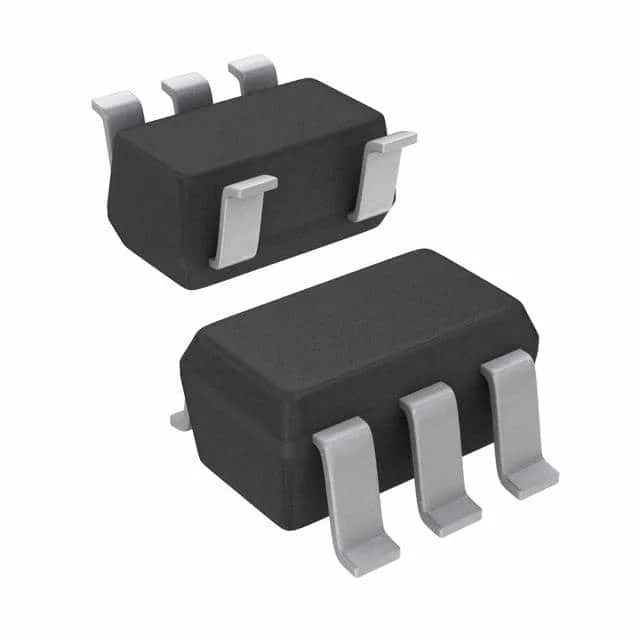
Automotive current sense in a SOT-23-5 footprint
The part comes in a SOT-23-5 package, making it a drop-in fit for space-constrained boards in engine control units, battery management, and motor-drive feedback paths.
1.3 MHz bandwidth and 15 µV offset — what they mean for shunt sensing
The 1.3 MHz bandwidth supports current-loop response in PWM-driven loads up to several hundred kHz switching frequency, which covers most automotive solenoid, injector, and DC-motor drivers. The 2.5 V/µs slew rate ensures the output settles within a microsecond on a fast load transient, so the ADC reading reflects the actual current, not a slew-limited artifact. The 15 µV input offset translates to a 1.5% error on a 1 mV shunt drop — if your design measures tens of millivolts across the sense resistor, this offset is small enough to ignore or cancel with a single-point calibration. The 20 µA input bias current flows into the shunt; for a 1 mΩ resistor that adds 20 nV of offset, negligible in practice.
Active lifecycle and AEC-Q100 traceability
The ROHS3 compliance is confirmed.