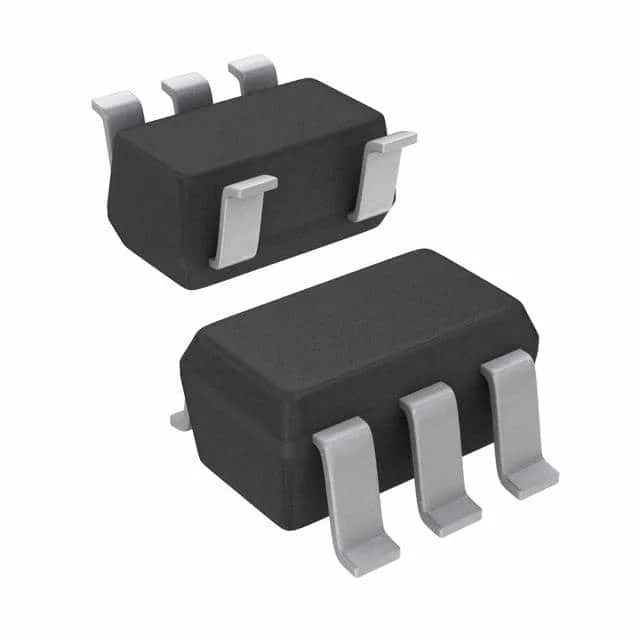
Automotive current sense amplifier in SOT-23-5
It is qualified to AEC-Q100, making it suitable for automotive under-hood and chassis-domain applications, as well as industrial motor drives and power management systems where extended temperature range and reliability are required.
1.3 MHz gain bandwidth — what it means for shunt monitoring
The 1.3 MHz gain bandwidth product sets the usable bandwidth for closed-loop current sensing. For a typical shunt amplifier gain of 20 V/V, the -3 dB bandwidth is around 65 kHz — sufficient for monitoring DC rail currents, solenoid drive waveforms, or PWM motor phases up to several tens of kHz. If your design requires faster transient capture (e.g., switching frequencies above 100 kHz), you would need a wider-bandwidth part like the INA4290A2IRGVR (1.1 MHz) or a dedicated high-speed amplifier.
Supply range 2.7 V to 20 V — rail flexibility
The supply voltage span from 2.7 V to 20 V covers the common automotive and industrial rails: 3.3 V, 5 V, and 12 V. At the low end, 2.7 V allows operation from a 3.3 V rail with margin for drop; at 20 V it can run directly off a 12 V battery line without an extra regulator. The 1.5 mA supply current is moderate — fine for always-on modules if the system can budget the quiescent draw.
That combination qualifies it for automotive under-hood environments (engine bay, transmission control, battery monitoring) and industrial outdoor or high-temperature equipment. The SOT-23-5 package is small enough for space-constrained modules but still hand-solderable for prototyping.
For BOM planning, this removes the last-time-buy risk that haunts older current-sense amplifiers. The part is ROHS3 compliant.