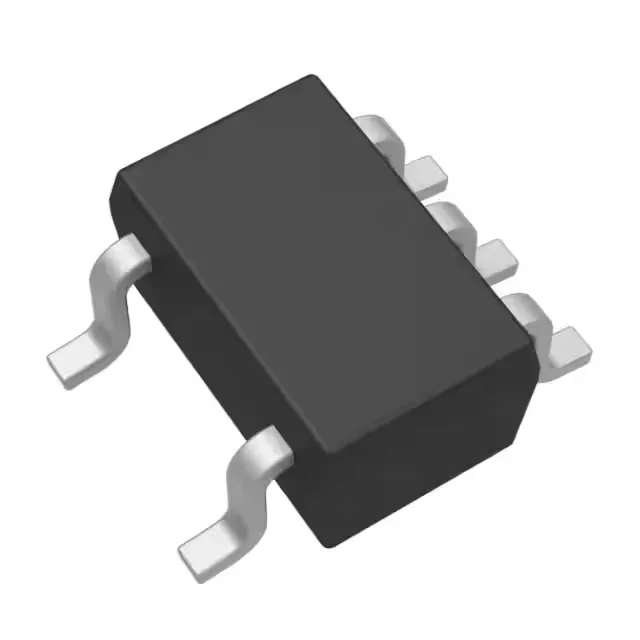
Current-sense amplifier in a 5-pin SC-70
The supply range from 2.7 V to 20 V lets it run off common rails (3.3 V, 5 V, 12 V) without a secondary regulator.
For a 100 mV shunt signal, the amplifier settles to within 1% in roughly 1 µs — fast enough for overcurrent detection in a 100 kHz switching converter.
Input offset and bias — what to budget in the measurement path
The offset contributes a fixed error at low shunt voltages; for a 10 mV full-scale signal the offset adds 0.15% error, which is acceptable for most automotive current-monitoring loops. The 20 µA bias current flows through the shunt — with a 1 mΩ shunt that adds 20 nV, negligible in practice.
Package and footprint — SC-70-5 layout notes
The SC-70-5 (also known as SOT-353) package has a 2.0 mm × 2.1 mm body with 0.65 mm pin pitch. At 370 µA supply current the self-heating is minimal — junction rise stays under 5°C even in still air. The supplier device package is SC-70-5.
It is ROHS3 compliant, with no exemptions for lead in solder. No successor part has been announced.