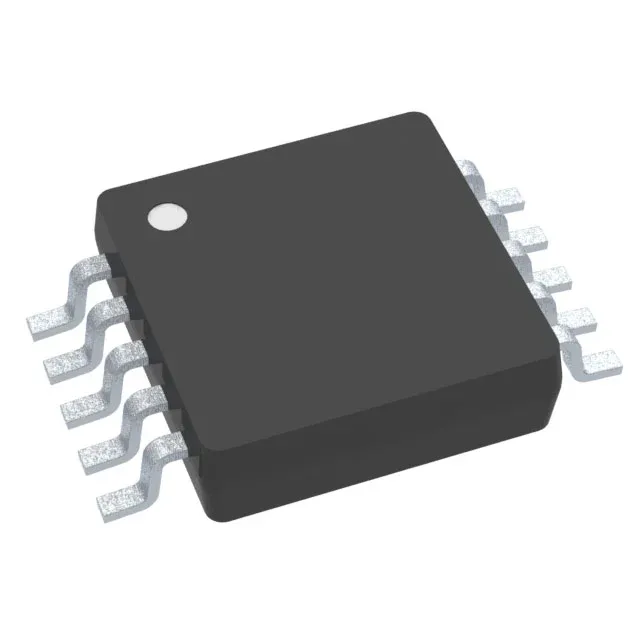
Dual current-sense amp for rail monitoring
The INA2181A2IDGST: It measures current via an external shunt resistor and outputs a voltage proportional to the sensed current, with a rail-to-rail output stage. The 210 kHz bandwidth and 2V/µs slew rate are sufficient for monitoring DC rails and moderate-speed transients in power supplies and motor drives.
The extended temperature range is a hard requirement for designs that see thermal cycling or sustained high ambient temperatures — the INA2181A2IDGST meets that without a separate automotive-grade suffix.
Input bias current — a real-world selection limit
The 75 µA input bias current is unusually high compared to general-purpose op-amps. This matters because bias current flows through the shunt resistor and adds an offset error. For a 10 mΩ shunt, 75 µA produces just 0.75 µV of additional offset — negligible. But if you are using a larger shunt (say 1 Ω) to measure very low currents, that same 75 µA creates a 75 µV error term, which can dominate the measurement. Keep the shunt value low enough that the bias-current voltage drop stays under your error budget.
Supply current and dual-channel power budget
Quiescent supply current is 356 µA per device (both channels active). In a battery-powered monitor, that draw is low enough to leave on continuously, but if you are multiplexing or gating power, factor it into the sleep-mode budget. The dual-channel configuration saves board area and BOM count compared to two single-channel current-sense amps, though the per-channel supply current is the same as running two separate parts.