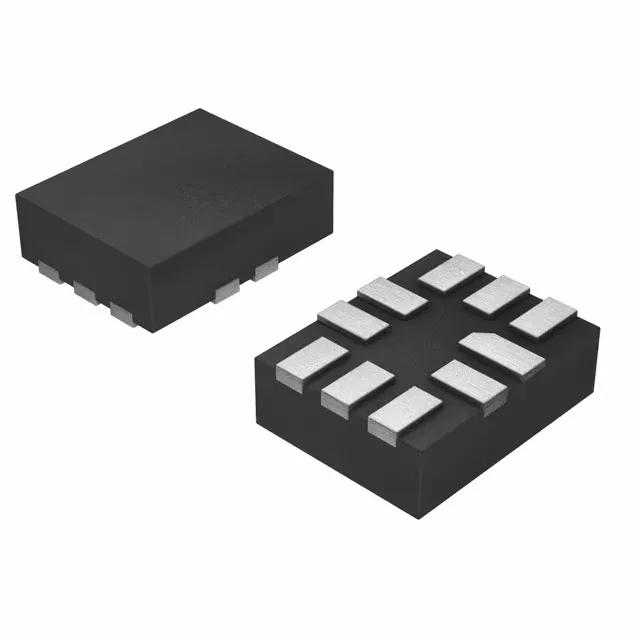
Current-sense amplifier for DC and low-frequency shunt monitoring
The Texas Instruments INA214CIRSWT is a dedicated current-sense amplifier in a 10-UQFN (1.8x1.4) package. It is a single-circuit device designed to amplify the small differential voltage across a current-sense shunt resistor and present it as a ground-referenced output. Key distinguishing characteristics include a very low input offset voltage of 1 µV, a gain-bandwidth product of 30 kHz, and a supply current of 65 µA. This combination targets applications where the current signal is DC or slowly varying — motor winding current, solenoid draw, battery charge/discharge, or power-rail monitoring in automotive and industrial systems.
The 30 kHz gain-bandwidth product and 0.4 V/µs slew rate define this part as a low-bandwidth sense amplifier. It is sized for DC accuracy and noise rejection, not for capturing fast current transients or switching edges. For a typical shunt voltage of 10 mV to 100 mV, the output settles in tens of microseconds. This is adequate for overcurrent detection with a response time in the millisecond range, for averaging ADC readings in a control loop, or for telemetry that updates at a few kilohertz. If the application requires monitoring current through a high-frequency switching converter (e.g., >100 kHz), a wider-bandwidth sense amp such as the INA254A1IPWAR (350 kHz) would be the correct choice.
The supply voltage span of 2.7 V to 26 V means it can run directly from an unregulated 12 V or 24 V battery bus without an intermediate regulator, simplifying the power tree. At the low end, 2.7 V allows operation from a single lithium cell near end-of-discharge. The 65 µA quiescent current makes it suitable for always-on sensing in battery-powered equipment where every microamp matters.
The ROHS3 rating covers the EU RoHS exemption categories, which is the standard requirement for commercial and industrial equipment sold into European markets.