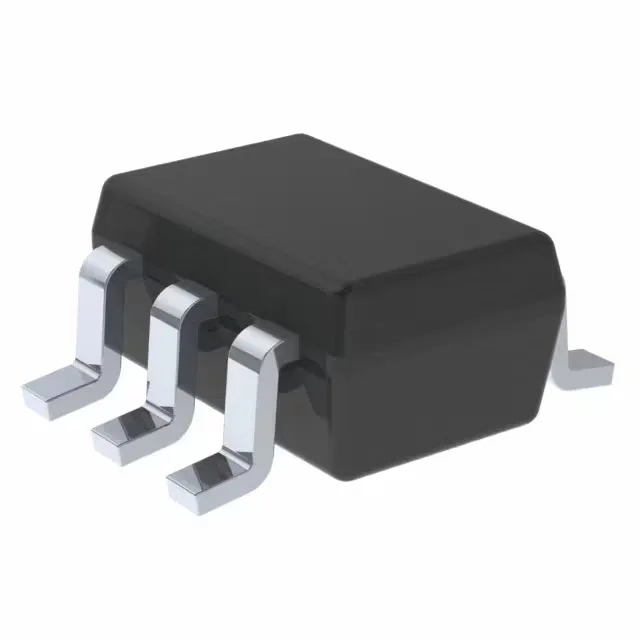
Zero-drift current sense amplifier in SC-70-6
Its zero-drift architecture holds the input offset voltage to 1 µV typical, which keeps the measurement error from drifting with temperature in a hot enclosure — a key advantage when stacking the error budget for a battery monitor or motor-phase current loop.
The gain-bandwidth product of 14 kHz limits the usable signal bandwidth to about 2.2 kHz for a gain of 100 V/V, which is adequate for DC current monitoring, battery charging profiles, and low-speed overcurrent detection. The 0.4 V/µs slew rate sets the large-signal response time; expect a settling time on the order of tens of microseconds for a step change in shunt voltage. For applications that need to capture fast fault transients or PWM ripple above a few kilohertz, a wider-bandwidth current-sense amplifier would be a better fit.
The INA214BIDCKR is supplied in a 6-pin SC-70-6 package (also known as SOT-363 or 6-TSSOP). The body is roughly 2.0 mm × 1.25 mm, with a 0.65 mm pin pitch. The device is surface-mount only; no exposed thermal pad, so the power dissipation is limited to about 200 mW at 25°C ambient, derated above that.
It is ROHS3 compliant.