What this current-sense amplifier does on your board
It measures current across a shunt resistor by amplifying the differential voltage, and its rail-to-rail output lets it swing close to the supply rails — useful when feeding an ADC with a limited reference range. The Zero-Drift architecture keeps the 2.5 µV input offset voltage stable over temperature, so you get accurate readings even at low millivolt drops across the shunt.
43 µA supply current and 37 kHz bandwidth — the trade-off
The 37 kHz gain-bandwidth product limits the signal bandwidth — you won't use it for fast overcurrent detection or switching-frequency ripple measurement. It's sized for DC or low-frequency current sensing where the power budget is tight and the signal is slow.
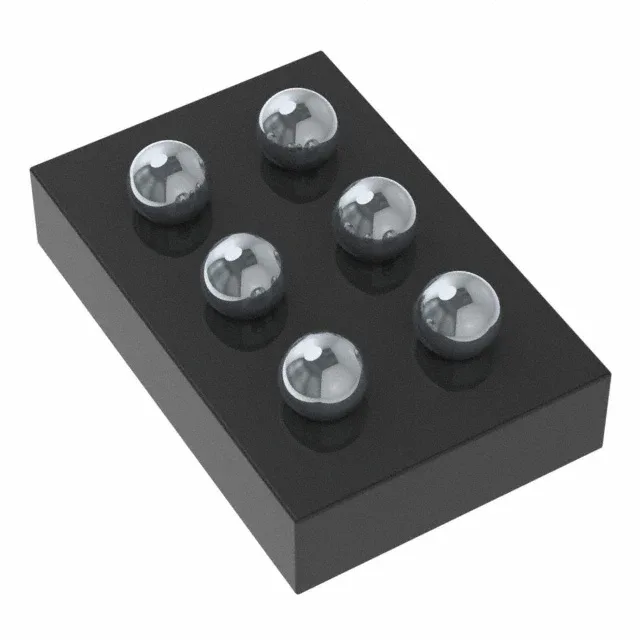
Rated from -40 to 125 °C, the INA191A2IYFDR covers automotive under-hood and industrial environments. The 6-DSBGA package is a wafer-level chip-scale package — no leads, just solder balls on the bottom. That means the board footprint is tiny, but rework requires a hot-air profile suited for BGA-style packages. The supplier device package dimensions are 1.17x0.77 mm, so plan your stencil aperture and pad geometry accordingly.