AEC-Q100 current sense for 40 V automotive rails
It measures current across a shunt resistor on supply rails up to 40 V, outputting a rail-to-rail voltage proportional to the sensed current. The 3 µV input offset and 500 pA input bias keep measurement error low even with milliohm shunts, while the 48 µA supply current suits always-on battery monitoring in engine control units, body controllers, and battery management systems.
37 kHz bandwidth — enough for DC load monitoring, not for switching ripple
The 37 kHz -3 dB bandwidth and 0.3 V/µs slew rate mean this part is designed for DC and low-frequency current measurement — think steady-state load monitoring, battery charge/discharge tracking, or fault detection on a 1 kHz to 10 kHz control loop. It will not capture fast switching transients from a buck converter or the current profile during a MOSFET turn-on. For those, you want a wider bandwidth part like the INA254A1IPWAR (350 kHz) or INA4290A2IRGVR (1.1 MHz), though both draw more supply current.
TSOT-23-8: small footprint, but watch the thermal pad
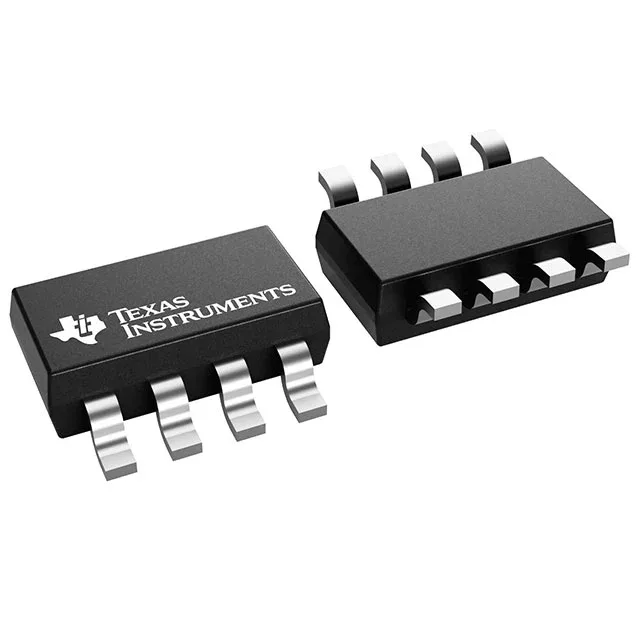
Housed in a TSOT-23-8 (the SOT-23-8 variant), this part fits tight PCB layouts in automotive modules like door controllers or seat ECUs.