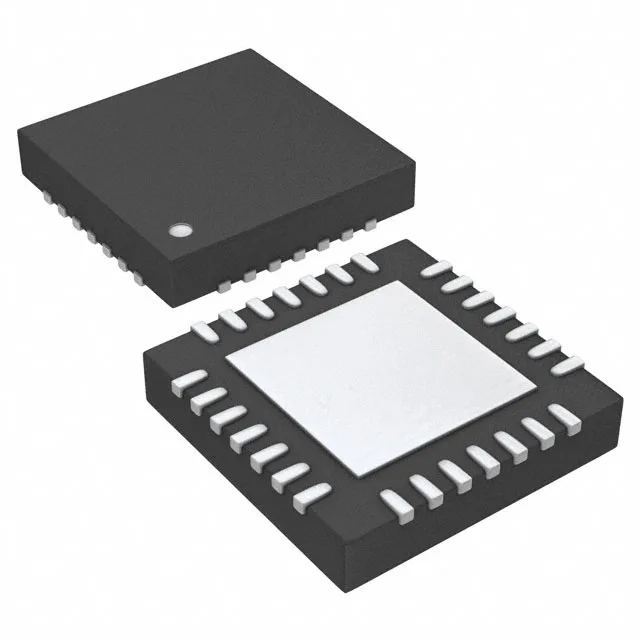
The Texas Instruments DRV8824RHDR is a fully integrated bipolar stepper motor driver that packs the control logic and power stage into a single 28-VQFN package. It drives one bipolar stepper motor with four half-bridge outputs built from power MOSFETs, handling load voltages from 8.2V up to 45V and delivering up to 1.6A continuous per winding. The step resolution is programmable from full-step down to 1/32 microstepping, which smooths low-speed torque ripple and reduces audible noise in applications like printer paper feeds, ATM mechanisms, and small CNC stage positioning.
Microstepping and voltage range — what drives the design decisions
The 1/32 microstepping capability is the feature that sets this driver apart for applications where vibration and acoustic noise matter. At 1/32 step the current in each winding is shaped into a 64-point sine/cosine table, giving the rotor 32 discrete positions per full step. That translates to 6400 steps per revolution with a standard 1.8° motor — enough for smooth low-speed rotation without mechanical damping. If the design only needs coarse positioning, the step resolution can be pinned to 1, 1/2, 1/4, 1/8, or 1/16 via the MODE pins, trading smoothness for simpler firmware. The 8.2V to 45V supply and load voltage range is the same rail — the driver's VM pin powers both the internal charge pump and the motor windings. At the low end, 8.2V is enough to overcome the MOSFET RDS(on) and the sense resistor drop for a 1.6A winding current; at 45V the driver can spin a motor at higher RPM before the back-EMF limits torque. The 45V ceiling also leaves margin for a 24V nominal supply with 10% ripple and a 48V transient, though the absolute maximum must be checked against the system's worst-case surge.
Thermal budget and package reality
The 28-VQFN with exposed pad is the only package option. The datasheet's thermal impedance numbers (not reproduced here) should be used to size the copper area for the expected ambient and duty cycle.
Logic interface and microcontroller compatibility
The control interface is logic-level — STEP, DIR, MODE0–MODE2, and ENABLE pins are 3.3V and 5V tolerant. A 5V microcontroller can drive them directly without level shifters, which simplifies the BOM. The driver does not include a serial interface; all configuration is done through the logic pin states, so the firmware just toggles STEP at the desired frequency and sets DIR for direction. The internal current regulation uses a fixed-off-time PWM scheme; the user sets the winding current via a reference voltage on the VREF pin and a sense resistor, not through register writes.
This makes it suitable for both prototyping and volume production without an immediate obsolescence gate. For dual-sourcing or a parametric alternative, the DRV8811PWPR offers a similar half-bridge bipolar stepper driver with a 1.9A output rating and 8V minimum load voltage, though its step resolution tops out at 1/8 microstepping.